
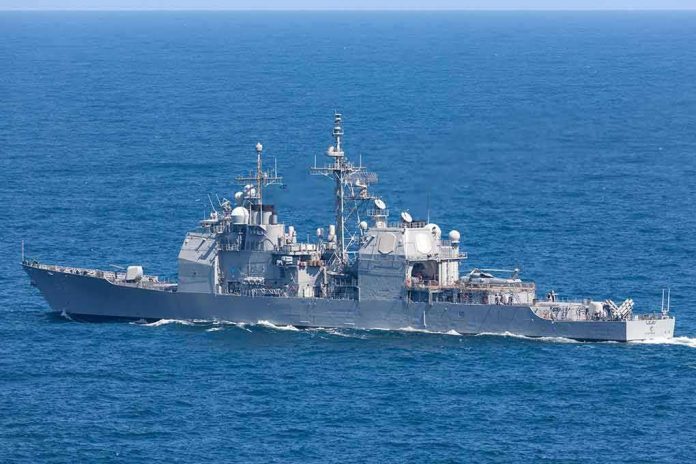
Overnight U.S. strikes hit targets deeper inside Iran again, widening a conflict that is now tied to shipping, air defenses, and nuclear fears.
Quick Take
- U.S. Central Command said the latest strikes targeted military command centers, drone sites, radar, and maritime assets in Iran.
- Officials said the campaign was meant to reduce threats to commercial shipping and civilian mariners in the Strait of Hormuz.
- Reporting shows the strikes were part of several consecutive nights of attacks, not a single isolated raid.
- The public record also shows a sharp split over interpretation, with U.S. officials calling the strikes defensive and critics calling them a sovereignty breach.
Strikes Reach Farther Into Iran
U.S. Central Command said it completed another round of strikes on Iran and hit more than 80 targets in one wave, then about 140 in another. The command said the targets included air defense systems, coastal radar sites, missile and drone sites, naval capabilities, and communication networks. That means the campaign went beyond a one-off response and became a sustained effort to damage Iran’s military reach.
Several reports placed the strikes along Iran’s coastline and near the Strait of Hormuz, including areas near Bandar Abbas and Qeshm Island. Reuters and other outlets also reported that some attacks followed earlier incidents involving commercial vessels in the strait. That sequence matters because it shows how quickly a maritime clash can turn into a broader air campaign, with each side saying it is answering the other side’s move.
Why Washington Said It Acted
Washington framed the strikes as protection for international shipping, not just punishment. CENTCOM said its goal was to degrade Iran’s ability to attack commercial shipping and innocent civilian mariners in the Strait of Hormuz. Other reporting said the Pentagon described the campaign as coercive pressure meant to force Iran to change course in negotiations. The U.S. side has also tied some strikes to Iran’s attacks on cargo ships and other vessels.
That public case is strongest on the narrow claim that the targets were military or dual-use and tied to maritime threats. It is weaker on wider questions about how much force was needed, how long the campaign should last, and whether repeated strikes inside Iran would reduce danger or deepen it. The record supplied here does not include an independent damage review or a full legal memo on necessity and proportionality.
What Iran’s Response Shows
The counter-narrative from Tehran is simple and blunt. Iran’s public framing in the supplied reporting presents the strikes as attacks on Iranian territory and as retaliation for earlier U.S. action. That argument is credible as a description of how Iran is talking about the war, but the record here does not provide a target-by-target rebuttal to CENTCOM’s claims. It also does not show independent proof that Iran’s response met any clear legal test for self-defense.
4 AM Top-of-the-Hour News
THE U-S HAS CONCLUDED AN EIGHTH ROUND OF STRIKES AGAINST IRAN President Trump ordered U-S CENTCOM to "open the gates of hell" upon Iran after two U-S service members were killed in Jordan. The latest attacks concluded late Saturday, Eastern time News… pic.twitter.com/bFpiIn4fBu
— Worldwide News Network (@WorldwideNNX) July 19, 2026
The bigger story is the same one that keeps showing up in Hormuz crises: fast strikes, slow verification, and almost no trust between the players. Both sides rush to claim they are defending trade, deterring escalation, or answering aggression, while the public is left with fragments. That gap helps fuel the suspicion, across party lines, that official narratives move faster than the facts and that ordinary people pay the price when leaders escalate first and explain later.
Sources:
facebook.com, centcom.mil, reuters.com, nytimes.com, aljazeera.com, apnews.com, bbc.com