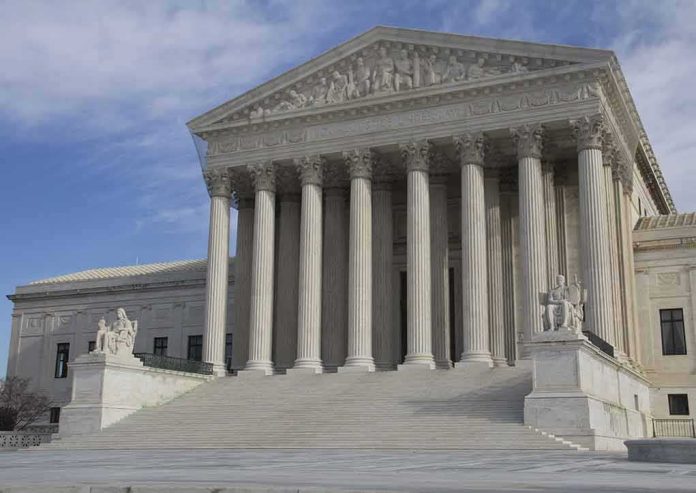
President Trump is now asking the Supreme Court to rehear a birthright citizenship case after the Court already rejected his order, and he says the issue is being turned into a profitable “scam.”
Quick Take
- Trump wants the Supreme Court to revisit its June 30 ruling on birthright citizenship.
- The Court already held that babies born in the United States are citizens at birth under the Fourteenth Amendment.
- Trump claimed billboards and signs near the southern border are advertising birthright citizenship for money.
- Supporters of the ruling say the Constitution and long-standing precedent already protect birthright citizenship.
Trump Revives the Fight After a Loss
President Trump is pressing the Supreme Court to rehear the birthright citizenship dispute after losing on the merits. CNBC reported that Trump called the bid a long-shot and said the Court’s ruling was wrong because, in his view, people are exploiting citizenship for profit. The move keeps one of his most controversial immigration fights alive, even after the Court said babies born in the United States are citizens at birth.
Trump signed Executive Order 14160 on January 20, 2025, and the executive branch said it would deny citizenship documents to some U.S.-born children of undocumented or temporarily present parents. The Supreme Court later rejected that effort. Trump’s new push does not change the ruling, but it does signal that the White House still wants the Court to take another look at the Constitution’s Citizenship Clause and the phrase “subject to the jurisdiction thereof.”
What the Court Already Decided
The core legal issue is simple to state and hard to settle politically. The Supreme Court has now said the Constitution’s Citizenship Clause protects birthright citizenship for children born on U.S. soil, and Reuters reported that the decision was a sharp defeat for Trump’s effort to restrict it. The Court’s opinion and the congressional research summary both show that the executive order turned on a narrow reading of “jurisdiction,” but the Court did not accept that reading.
That matters because the legal fight is not only about immigration. It is also about whether a president can use executive power to narrow a constitutional rule that has been understood for generations as covering most U.S.-born children. The ruling also left Trump facing a problem that goes beyond one order: any real change to birthright citizenship now looks like a fight over the Constitution itself, not just policy.
Why the “Scam” Claim Sticks
Trump’s rhetoric gives this case more political heat than a normal courtroom dispute. CNBC reported that he claimed signs and billboards near the border advertise birthright citizenship and that “billions of dollars” can be made from the system. That language fits a broader pattern in which the administration frames immigration rules as fraud control. It also helps explain why supporters see the case as an attack on abuse, while critics see it as an attempt to rewrite a settled right.
Trump petitions SCOTUS to allow his EO on mail-in ballots
The Dean’s List
With-Dean Bowen#AmericaOutLoud🇺🇸@OutLoudNews https://t.co/VhlTw1oclz via @OutLoudNews— kiptomylou (@KiperlyW) August 2, 2026
The problem for Trump is that the public record in the materials provided leans the other way. The Congressional Research Service says the Supreme Court has interpreted the Citizenship Clause only sparingly, but it also summarizes the executive order as an effort to exclude children born here to undocumented or temporarily present parents. Reuters and other outlets describe the June ruling as a rejection of that approach, which means the rehearing request is starting from a position of weakness.
Why This Fight Still Matters
Birthright citizenship touches more than immigration law. It affects who counts as American at the moment of birth, what agencies must recognize, and how far a president can go when he says an old rule has been misunderstood. For voters already frustrated with government overreach, elite legal fights, and policy made by court order or executive order, this case looks like another example of Washington using power first and fighting about limits later.
The wider lesson is that the Court has not ended the national argument. It has only drawn a line that Trump now wants it to revisit. If the justices refuse to rehear the case, the June ruling stands as the current law. If they do take it up again, the fight will move back to the same core question: whether birth on U.S. soil is enough, or whether the executive branch can narrow citizenship by reinterpreting the Constitution.
Sources:
pjmedia.com, congress.gov, youtube.com, brennancenter.org, scotusblog.com, constitutioncenter.org