
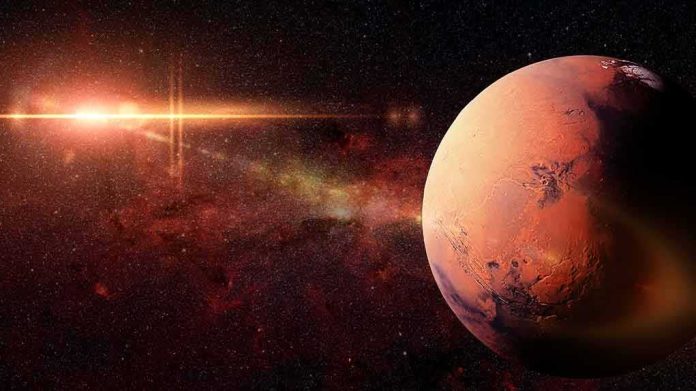
Astronomers confirmed a planet still in its birth cloud, and it is the youngest ever found.
Story Snapshot
- Scientists confirmed Elias 2-24 b, a Jupiter-size world under one million years old.
- The planet sits inside the dusty disk around its star about 450 light-years away.
- Data from NASA-linked archives and observatories made the confirmation possible.
- The find suggests giant planets can form far faster than some models predicted.
A record-setter inside its natal disk
NASA reports that Elias 2-24 b is now the youngest known planet, with an age under one million years. The planet orbits a very young star and remains buried in the same dust and gas that built it. That location matters. It is the smoking gun of ongoing formation, not a quiet, finished world. The team built the case with direct imaging tools and careful checks across existing data. The result sets a clear new age record and anchors a benchmark system for study.
The star Elias 2-24 has drawn interest for years because of its bright, structured disk. Earlier radio images showed rings and gaps where planets could grow, like grooves on a vinyl record hinting at the needle’s path. Those gaps guided follow-up work. The latest confirmation pins a point source to the disk, ties it to the system, and characterizes its mass near that of Jupiter. Seeing a world this young supports the idea that giant planets can form quickly while the disk is still thick.
How the team nailed the age and the identity
The research tied together high-contrast imaging, coronagraphy, and deep archives that NASA helps fund and organize. Coronagraphs block the glare of the star so faint neighbors can stand out. Archival data adds time, letting astronomers track motion and rule out background objects. Put together, the signal matches a bound planet embedded in the disk, not a stray star. Independent reports echo the same core facts in plain terms: size like Jupiter, age under one million years, and youth record.
Direct imaging of such young planets is rare because newborn systems are messy. Dust scatters light. Gas glows. Signals blend. That is why this case matters. Prior work mapped the disk’s rings and hinted at forming planets, but without a clear, confirmed body in the gap. Elias 2-24 b now links the disk structure to an actual planet. That link lets scientists test formation ideas against something they can point to and measure, not just infer from patterns in dust.
Why fast formation changes the playbook
Many classroom charts show planets taking millions of years to assemble. Elias 2-24 b compresses that story. A Jupiter-mass world under a million years old means nature can move fast when raw material is close and thick. Core accretion models can still work if pebble flow and gas cooling run hot and efficient. Disk instability models gain ground in zones where gas clumps collapse quickly. The practical outcome is not a winner-take-all claim, but tighter targets for future tests.
A planet less than 1 million years old… and we just found it. 🤯🌌
Elias 2-24 b is now the youngest known planet, still growing from the gas and dust around its young star, about 450 light-years away.
Sometimes the universe really reminds you how little we still know. 🚀✨…
— Ansh Rai (@the_anshrai) September 17, 2026
Common sense says you trust what shows up across solid, named sources. NASA’s account is specific and sourced, and it lines up with specialty records that flagged Elias 2-24 as a planet-forming site years ago. That coherence is what counts. It keeps the hype in check and the facts up front. Expect sharper mass, temperature, and orbit numbers next, as telescopes watch this world clear a path in its disk. The clock is running, and this “baby” is growing fast.
Sources:
sciencedaily.com, milenioyems.cl, ui.adsabs.harvard.edu, science.nasa.gov