
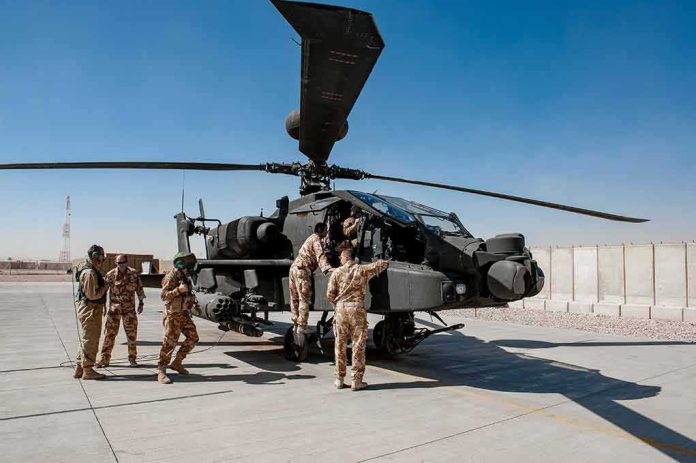
As U.S. bombs Iran for a ninth straight night, another American service member has died in a war many Americans never clearly agreed to or fully understand.
Story Snapshot
- U.S. forces hit Iran for a ninth night after a service member died handling an unexploded Iranian drone in Iraq.
- The strikes follow an Iranian missile and drone attack on a U.S. base in Jordan that killed at least two troops and left one missing.
- Washington calls the operations “self-defense,” while Iran claims its own missile strikes on U.S. bases are retaliation.
- As the cycle of attack and response deepens, Americans across the political spectrum see another open-ended war run by distant elites.
New U.S. Casualty Sparks Ninth Night of Strikes
U.S. Central Command said a U.S. service member was killed Saturday in northern Iraq during a “controlled detonation” of unexploded ordnance from a downed Iranian one-way attack drone. Another service member was wounded with what officials described as a minor injury. Military leaders said this death brought the total number of American troops killed in the Iran war to 17 since major fighting began in late February. Within hours, U.S. forces launched yet another round of strikes on Iranian targets.
U.S. officials said the latest strikes hit units of Iran’s Islamic Revolutionary Guard Corps and related sites they believe are tied to recent attacks on American troops. The Pentagon framed the operations as necessary to protect U.S. forces deployed across the region. Central Command described the actions as “self-defense strikes” aimed at missile systems, military infrastructure, and assets used to threaten U.S. troops and shipping lanes near the Strait of Hormuz. President Donald Trump has warned Iran that U.S. responses will continue to be “hard” if attacks persist.
Deadly Iranian Attack in Jordan Set Off Escalation
Friday’s turning point came in Jordan, where an Iranian missile and drone barrage hit Muwaffaq Salti Air Base, a long-standing Jordanian facility that also hosts U.S. forces. U.S. officials said at least two American service members were killed, one remains missing, and four others were treated and released from a hospital in Jordan. Iranian state media and the Islamic Revolutionary Guard Corps boasted that they fired ballistic missiles at U.S. aircraft and hangars at the base and at nearby Aqaba airport.
Central Command and the Pentagon blamed Iran directly for the Jordan attack, not just local proxy militias. Iranian leaders, for their part, portray these strikes as retaliation for earlier U.S. attacks on Iranian territory and forces, including Operation Epic Fury launched in February with Israel, which targeted Iran’s missiles, navy, and security infrastructure. Jordanian sources later said most incoming missiles aimed at the Azraq area, where the base is located, were intercepted and caused no reported casualties, highlighting the fog and spin that now surrounds each strike.
Pattern of “Self-Defense” and Tit-for-Tat Strikes
The current clash fits a pattern that has been building for years. After attacks on U.S. troops in Iraq, Syria, Jordan, and now Kuwait, Washington has repeatedly answered with airstrikes described as “self-defense” against Iran or Iran-backed groups. A Military Times analysis previously counted more than five dozen attacks on U.S. bases by Iran-linked militias, with at least 60 American personnel reporting mostly minor blast injuries. Under Trump’s second term, the tempo of U.S. strikes across several countries has surged.
Legal and diplomatic documents show how this cycle is framed. A State Department legal paper on Operation Epic Fury said U.S. goals included destroying Iranian offensive missiles and making sure Iran “will never have nuclear weapons.” Central Command statements on more recent actions emphasize limited, targeted strikes to remove immediate threats and protect U.S. forces and shipping. Yet Iran’s leaders claim their missiles at U.S. bases in Jordan, Kuwait, Bahrain, and elsewhere are justified responses to U.S. attacks on their soil and assets.
Regional Risks Grow as Public Trust Shrinks
Iran’s latest salvos show how quickly this war can widen. Iranian media and officials have pointed to attacks or attempted attacks on U.S.-linked targets in Jordan, Kuwait, Bahrain, and around the Strait of Hormuz, including missiles and drones aimed at bases and cargo ships. U.S. commanders report intercepting many incoming missiles, but not all, as seen in the deadly hits on Jordan and Kuwait earlier in the conflict. Each new round of strikes raises the chances of a misfire that drags more countries into deeper fighting.
🚨 10‑DAY PAUSE PROPOSED IN US‑IRAN STRIKES.
Mediators have floated a plan for a 10‑day halt in US‑Iran strikes as both sides look for a way to revive their interim deal. The proposal comes amid heavy fighting, including nine straight nights of US strikes and Iranian retaliation… pic.twitter.com/IQYX7PiiKE
— The Content Factory (@tcf_updates) July 20, 2026
For many Americans watching from home, the bigger question is who this war really serves. Conservatives see another far-off fight while borders at home stay porous and costs rise. Liberals see working families paying for bombs while social needs go unmet. Both sides see agencies and political elites making life-and-death choices with little real debate or sacrifice in Washington. The steady drumbeat of “self-defense strikes” and “proportional responses” sounds to many like another open-ended conflict where regular citizens bear the cost and distant decision-makers hold the power.
Sources:
independent.co.uk, usatoday.com, nbcnews.com, al-monitor.com, bbc.com, facebook.com, cbsnews.com, dailymotion.com, en.wikipedia.org, middleeasteye.net, caliber.az, newarab.com, militarytimes.com, lawfaremedia.org, centcom.mil, wtae.com, nebraskaexaminer.com