
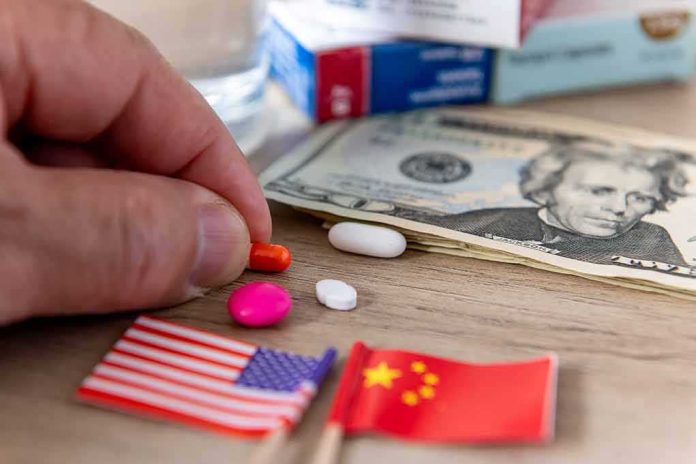
Counterfeit GLP-1 drugs don’t just siphon revenue from a blockbuster therapy; they short-circuit every safeguard the U.S. drug supply chain is built on, turning a high-demand injectable into a vector for consumer deception and potential harm.
At a Glance
- A federal grand jury indicted Swapnadip Roy and Vicky Ramancha in Florida for an alleged transnational scheme trafficking counterfeit Ozempic.
- The indictment charges conspiracy, smuggling, and trafficking in counterfeit prescription drugs tied to products sourced from unauthorized suppliers in China.
- Prosecutors say the operation used imitation packaging, pen labels, inserts, and needles to pass fakes to U.S. distributors at steep discounts.
- The case lands amid heightened FDA and CBP enforcement against counterfeit and unapproved GLP-1 products as demand and shortages feed parallel markets.
What the indictment alleges and why it matters
Federal prosecutors in the Middle District of Florida unsealed charges against two Indian nationals, Swapnadip Roy and Vicky Ramancha, alleging a conspiracy to smuggle and sell counterfeit Ozempic into the U.S. market. The charging document sets out six counts: one count of conspiracy to commit smuggling and to defraud the United States, three counts of smuggling, and two counts of selling and holding for sale counterfeit drugs—each a felony under federal law designed to protect the integrity of the pharmaceutical supply chain. While an indictment is an allegation, the filing squarely frames the case as a classic counterfeit-drug trafficking matter, with foreign sourcing, deceptive packaging, and downstream distribution targeting price-sensitive buyers.
The government’s theory is straightforward: beginning around July 2023 and continuing through April 2024, Roy and Ramancha obtained counterfeit Ozempic from unauthorized suppliers in China. They and unnamed co-conspirators allegedly sold that material—complete with imitation packaging, package inserts, pen labels, and needles—to U.S. distributors at “deeply discounted prices,” an economic tell that routinely flags diverted or fake product in pharmaceutical investigations. This is not a victimless financial crime; counterfeit injectables can contain the wrong active ingredient, the wrong dose, or contaminants. FDA has repeatedly warned that counterfeit semaglutide products discovered in U.S. channels are illegal and risky for patients who may rely on them for glycemic control or weight management.
How counterfeit Ozempic schemes work, operationally
Counterfeiters exploit pressure points created by scarcity, price, and complexity. GLP-1 analogs like semaglutide are cold-chain, pen-based injectables with serialized packaging and a distribution path that, in the legitimate market, runs manufacturer to licensed wholesaler to licensed dispenser. Bad actors attack each layer. Upstream, they print near-identical packaging and labels, often cloning legitimate lot numbers or brand assets to evade cursory inspection. Midstream, they enlist freight forwarders and use misdeclared shipments or transshipment routes to skirt customs targeting. Downstream, they market to gray-market distributors and clinics at prices that undercut the authorized channel by margins only counterfeits can sustain.
The Florida indictment’s details map onto this playbook: unauthorized Chinese sourcing, imitation accessories intended to deceive, and discounted sales to U.S. distributors. CBP ports have reported seizing Ozempic and related GLP-1 shipments bearing counterfeit or unapproved product characteristics; at the Port of Cincinnati, officers have intercepted multiple such consignments as demand for weight-loss injectables surged. When the products slip through, the counterfeiters count on the aura of brand familiarity and patient desperation to do the rest.
The enforcement environment around GLP-1 counterfeiting
Regulators and prosecutors have sharpened their focus on semaglutide and tirzepatide as shortages and off-label demand expanded. The Department of Justice has pursued criminal cases tied to counterfeit or misbranded GLP-1 products, and FDA has issued multiple public alerts specific to counterfeit Ozempic discovered within U.S. supply chains, emphasizing that such products are illegal and potentially harmful. FDA’s public counterfeits page chronicles repeated warnings and updates, reflecting an evolving threat surface as counterfeiters adapt their packaging and shipping tactics.
Congressional testimony and CBP reporting underscore the scale of attempted imports: semaglutide-class shipments from foreign manufacturers that fail registration and other compliance checks continue to be flagged; enforcement, while significant, contends with a high volume and diversified routing strategies by traffickers. Against that backdrop, cases like United States v. Roy and Ramancha serve a dual purpose—removing alleged actors from the field and publicizing the anatomy of the fraud to harden buyers and intermediaries against it.
Supply-chain integrity: how legitimate product is authenticated
Authentication of a legitimate Ozempic pen is a layered process: packaging security features, lot and serial number verification against manufacturer records, examination of pen construction and labeling, and, when necessary, laboratory assay to confirm the active ingredient, concentration, and sterility. Manufacturers maintain reference specifications that enable regulators and law enforcement to distinguish genuine from counterfeit quickly; FDA laboratories can run comparative testing that treats the genuine article as a control sample. In counterfeit cases, prosecutors often rely on a mix of seizure documentation, chain-of-custody records, and expert testimony to establish that what was shipped or sold could not lawfully be genuine—because it bears false marks, fails composition tests, or traces to an unregistered facility outside the authorized supply chain.
The Florida charges foreground the deception stage—packaging and accessories crafted to impersonate Novo Nordisk’s product—and the discounting strategy that moved volume through U.S. intermediaries. Those two facts alone, if proven, are typically sufficient to satisfy core elements of trafficking in counterfeit drugs; composition testing strengthens the case, but counterfeiting need not hinge on toxic content to be criminally actionable.
Why distributors and clinics are targeted—and how to respond
Counterfeiters rarely go straight to pharmacies; they prefer distributors, clinics, and weight-loss programs sitting at the blurry edges of the supply chain, where procurement teams may be less familiar with manufacturer traceability tools and more responsive to price variance. A $100-per-pen delta multiplied across a clinic’s monthly volume becomes a meaningful budget line, dulling suspicions that should be sharpened by market realities. The countermeasure is procedural and cultural: insist on sourcing only through licensed, authorized channels; verify DEA/FDA/State Board credentials; audit invoices and lot numbers against manufacturer portals; and maintain cold-chain log discipline that would be impossible for a gray-market operator to fake end-to-end. When in doubt, engage the manufacturer’s anti-counterfeiting unit or FDA’s Office of Criminal Investigations promptly.
Patients should never purchase Ozempic without a prescription or outside a licensed pharmacy. FDA’s advisories are blunt on this point because the incentives elsewhere are misaligned: online sellers and social-media vendors are structurally rewarded for speed and price, not verification and pharmacovigilance.
A federal grand jury in the Middle District of Florida charged two Indian nationalists, Swapnadip Roy, 33, and Vicky Ramancha, 37, both Indian nationals, with conspiracy and smuggling related to an alleged transnational counterfeit prescription drug distribution scheme. The…
— VICTSIN (@VICTSIN01) September 29, 2026
The stakes for patients and for the market
GLP-1 therapies have reshaped obesity and diabetes care, and with that clinical importance comes economic gravity. Counterfeit penetration erodes trust, deters adherence, and exposes patients to avoidable risks—from subtherapeutic dosing that masks as “treatment failure” to contamination risks far more acute in injectables than in solid oral forms. For legitimate manufacturers and payers, counterfeits corrupt utilization data and complicate pharmacovigilance signals; for prosecutors, they present a clear statutory target. The Florida indictment sits squarely in this ecosystem: a case about more than two defendants, pointing to the systemic vulnerabilities counterfeiters exploit and the enforcement architecture moving to close those gaps.
Sources:
cbsnews.com, justice.gov, cnbc.com, foreignpolicyjournal.com