
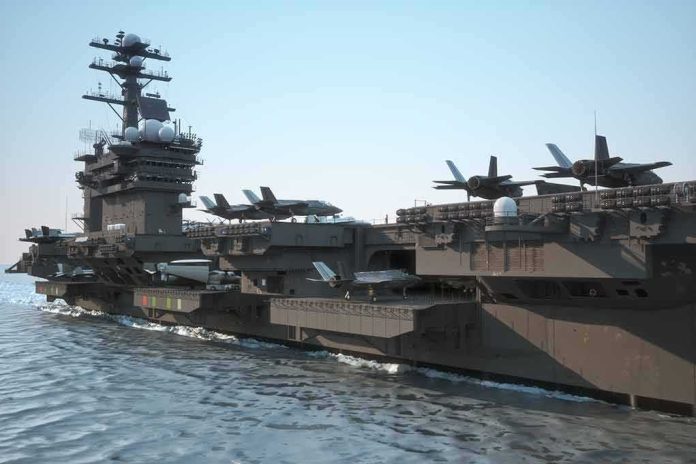
The modern U.S. carrier force generates unmatched combat power, but it does so by leaning hard on time at sea; when deployments stretch from months into most of a year, the human and material costs compound in ways the Navy’s doctrine anticipates only imperfectly.
At a Glance
- USS Abraham Lincoln’s latest cruise stretched into a 10th month, an outlier in duration but not in underlying pressures that drive extensions.
- Navy leadership framed the extension as mission-driven, citing high combat output and combat-zone time.
- Reports of suicide attempts and overboard incidents during the deployment sharpened concern about crew well-being; Navy officials disputed a spike aboard the ship while later confirming multiple attempts across the strike group.
- Longer deployments recur when operational demand outpaces the maintenance-and-training cycle the Navy plans for, a readiness pattern documented over years.
What “never home” really means for a nuclear carrier
“Never home” is not literal; it is the felt reality when a carrier strike group exceeds the service’s preferred rhythm by months. The USS Abraham Lincoln left San Diego in November 2025 and was still forward late the following September, its deployment crossing into a 10th month when the strike group pulled into Guam. Acting Navy Secretary Hung Cao called the cruise a success and said the ship would return “as part of a planned rotation,” while also acknowledging the extension occurred because the mission demanded it. The same statement put hard numbers behind the tempo: 266 days deployed, 200 in a combat zone, more than 10,000 sorties, and 1.5 million pounds of ordnance expended. Those figures are not abstract metrics; they are a proxy for every hour sailors stood the watch and every maintenance evolution compressed to keep the air wing flying.
Carrier doctrine has long promised presidents rapid, flexible power projection from the sea, independent of foreign basing constraints. The Navy’s own descriptions are clear on that value proposition: forward presence, deterrence, sea control, and strike options on short notice. In crisis, carriers are the nation’s first-resort instrument, by design. But that design presumes a deployment cycle that alternates intense use with time to recover the ship and the crew. When the “use” side grows faster than the “recover” side, stress migrates from policy charts into steel and people.
How the carrier machine actually generates tempo
A Nimitz-class carrier is not a ship but a system of systems: nuclear propulsion plants, catapults, arresting gear, aviation depots afloat, and a small city’s worth of hotel services under combat conditions. To keep the flight deck productive, thousands of sailors run a 24-hour industrial operation at sea. The strike group’s escorts add anti-air, anti-surface, and anti-submarine coverage; logistics ships and flyaway resupply package the food, parts, and ordnance that make persistence possible. In that context, the Lincoln’s sortie count and ordnance expenditure signal sustained, high-demand operations rather than presence patrols. Sustained tempo drives predictable second-order effects: more parts consumed, more intermediate maintenance, more human fatigue—each manageable in moderation, but synergistic when deployment lengthens.
The Navy’s formal training-and-readiness guidance treats carrier strike groups as forward-deployed and flexible, built to support the President and combatant commanders across the range of military operations. That flexibility has always entailed a managed readiness trade: meeting today’s demands at the cost of tomorrow’s maintenance elbow room. Naval leaders have conceded as much in general terms, noting that frequent and extended deployments accelerate wear and increase repair requirements. The Lincoln cruise demonstrates the trade made visible.
Where the strain showed: incidents, families, and official pushback
Long cruises test ships and crews. During the Lincoln deployment, reporting surfaced on multiple suicide-related incidents, including a sailor who went overboard in early August and another prevented by shipmates in March; CNN quoted the Navy at the time as saying they had not observed an increase in suicidal ideations or attempts aboard the ship. Weeks later, officials confirmed that eight sailors across the strike group had attempted suicide during the deployment, one of them the overboard case from August. The Navy’s later confirmation answers the binary “did it happen” question while still resisting a simple causal link between deployment length and individual acts. That caution is reasonable—causation in mental health is multifactorial—but the cluster, combined with extraordinary duration, is enough to demand scrutiny of command climate, access to care, and scheduling practices during surge conditions.
Family testimony and veteran commentary described rough living conditions—shortages, plumbing problems, morale fraying—typical of a large ship under sustained load and difficult logistics, but harder to dismiss when shore time recedes on the horizon. The Guardian and BBC amplified those accounts and the countervailing Navy line that health and well-being remained a priority and that extended deployments, while straining crews and families, were being managed. Across that back-and-forth, two truths co-exist: the Navy is correct that carriers exist to absorb operational shock; families are correct that people, unlike machines, cannot be reset with a depot-level overhaul.
Is this an aberration or a pattern?
The Lincoln’s tenth month makes it an outlier in severity, but not a unicorn. Over the past decade, independent analyses and government auditors have documented the creep from six- to seven-month “standard” deployments toward longer cruises during surge periods, with compressed maintenance and training between them. The Navy’s own planning frameworks, such as the Optimized Fleet Response Plan, were designed to rationalize that cycle; the problem is not that the plan does not exist, but that operational demand repeatedly outruns it. In that light, a nine- or ten-month deployment is better understood as a stress test of a system already running hot, not a one-off curiosity.
Crucially, the available public record on the Lincoln pinpoints this ship and this deployment; it does not, by itself, prove a fleetwide, permanent norm of ten-month cruises for nuclear carriers. Nor does it fully trace causation from time at sea to specific mental-health outcomes—command investigations and medical records, which would sharpen that picture, are either classified or unreleased. Still, when the service itself highlights 200 combat-zone days and five-figure sortie counts, the signal is unmistakable: this was not a routine “presence” lap.
Hachikō was measured for a breed registry in 1932: 64.5 cm at the shoulder, about 41 kg. Two necropsies, 75 years apart, agree on what killed him. A Tokyo commuter's dog with better paperwork than most people.#History #Dogs https://t.co/ZtR6nyfSbU
— Likes Dogs more than humans (@Dogs_are_First) September 30, 2026
What responsible stewardship looks like going forward
There are three practical lanes that do not require a culture war to endorse. First, transparency: the command investigation into overboard and suicide attempts, aggregate mental-health referral data for the strike group, and safety summaries should be releasable in sanitized form without compromising operations. That would move the discussion from dueling anecdotes to evidence. Second, cycle discipline: if leadership judges a mission truly demands a double-digit-month deployment, then the follow-on plan must protect maintenance integrity and crew recovery, not merely promise to. The Navy already acknowledges the wear that extensions impose; the budget, shipyard schedules, and manning models must reflect that reality. Third, on-deck mitigation: expanded embedded behavioral health teams, chaplains, and tele-mental health access are necessary but insufficient if watchbills, work/rest ratios, and liberty-in-port opportunities are not engineered to support them during high-tempo cruises.
Why this matters beyond one ship
Carriers are strategic signaling devices and wartime workhorses; they shape adversaries’ risk calculus precisely because they can sustain pressure far from home. That credibility, however, rests on a social contract with the people who operate them. When sailors and families believe the rotation ladder is breaking under them, retention suffers, experience drains away, and the very readiness the Navy is trying to buy with longer deployments is eroded. The Lincoln’s numbers—months at sea, combat days, sorties—prove what a carrier can do under strain. The next test is whether the institution can absorb the lessons with the same candor it applies to battle damage assessments: fix what broke, reinforce what held, and avoid assuming that sheer endurance is a strategy.
Sources:
19fortyfive.com, cnn.com, bbc.com, navy.mil, nytimes.com, navytimes.com, theguardian.com