
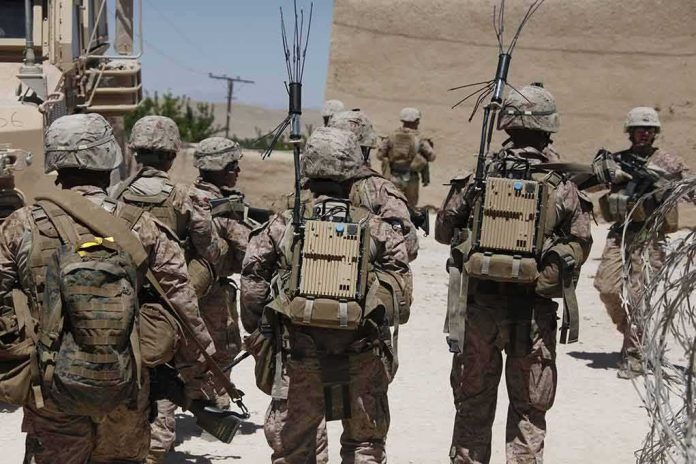
When a president declares the last American forces are leaving Iraq and the Pentagon and field commands say the same day that the drawdown is done, the long war has reached a hinge: strategy shifts from a troop presence to what comes after — deterrence without boots, diplomacy without a brigade, and intelligence without a joint operations room.
The Short Version
- President Trump publicly announced that the final U.S. troops were leaving Iraq, framing the exit as orderly and decisive.
- U.S. military reporting the same day confirmed completion of the withdrawal and the end of the deployed mission.
- The administration cast the move as a shared U.S.–Iraq “victory” tied to ISIS’s defeat and a pivot to bilateral security ties.
- The exit fits a recurring Iraq pattern: withdrawals celebrated as closure, followed by debate over residual commitments and risks of reversal.
What happened: a declared end to the U.S. troop presence
On September 30, 2026, President Trump said, “the last American Forces are leaving Iraq,” calling the departure the end of a “very expensive excursion into Hell” and presenting it as a choice to go home rather than remain in an open-ended mission. He described the exit as complete and orderly — the kind where you “take every screw” — and explicitly characterized the moment as a victory for both the United States and Iraq, achieved after the Islamic State’s territorial caliphate was shattered. The same day, wire and broadcast reporting, drawing on Pentagon and theater-level briefings, stated the U.S. withdrawal from Iraq was finished; the mission ended, and a transition to a bilateral security relationship would follow.
The timing matters. Announcements from Washington have symbolic weight, but they turn consequential when the operating command confirms that personnel and equipment have cleared the last airfield, in this case Erbil, and that coalition structures are shutting down. That is what the public record describes — the base departures, the closeout of the anti-ISIS campaign architecture, and a handoff to state-to-state defense ties calibrated to Iraqi sovereignty and U.S. regional interests.
How it works: from a coalition mission to bilateral defense
For twelve years, Operation Inherent Resolve provided the legal and operational scaffolding for U.S. and partner forces to support Iraqi units — airpower, intelligence, advisory teams, and logistics. Ending that mission means the coalition’s authorities, command centers, and habitual liaison channels stand down. What replaces them is a thinner, more diplomatic lattice: defense attachés, armaments programs under Foreign Military Sales, and episodic joint exercises. In practice, intelligence sharing becomes more selective and often routed through embassy country teams; counterterrorism air sorties cease to be routine and, if contemplated, demand fresh permissions and political cover on both sides.
Trump’s framing — we came to defeat a caliphate and it no longer exists — maps onto that transition logic. When the core military task is judged complete, you stop structuring your presence around it. The argument is not only financial or moral; it is organizational. The coalition task force is a wartime instrument. A bilateral defense relationship is peacetime statecraft, even if the neighborhood remains rough.
How we got here: the long arc of entry, exit, and return
Iraq policy has moved in cycles. The United States invaded in 2003, withdrew all forces in 2011 under a Status of Forces Agreement negotiated in 2008, then returned in 2014 at Baghdad’s request after ISIS swept across Mosul and much of the Tigris-Euphrates corridor. By 2026, with ISIS’s territorial project dismantled and Iraqi forces rebuilt around counterterrorism and armored formations, pressure mounted again to end the foreign troop presence; Baghdad’s politics and Washington’s bias against “forever wars” aligned to put a date on closure.
Trump’s own rhetoric sits in that tradition. He had long argued against indefinite deployments, and his second-term team treated Inherent Resolve as a discrete campaign: defeat the caliphate, then get out. The step now completed is the execution of that thesis — validated not by slogans, but by the practical markers that matter in military affairs: base clearances, unit rotations home, and command deactivation orders as relayed by the Pentagon’s public affairs and combatant command channels.
Competing readings without a factual dispute
There is no serious contest over the basic facts: the president declared the troop exit; the U.S. military confirmed completion. The disagreements that do exist are interpretive. One reading emphasizes closure and sovereignty — fewer American targets for militia rockets, fewer friction points with Iran, and an Iraqi state that stands on its own. Another stresses residual risks — intelligence gaps without U.S. enablers, a looser grip on ISIS cells, and the political space Iran-aligned factions may exploit in Baghdad and the security ministries. Both views are legible precisely because Iraq has lived both outcomes since 2003: celebrated exits and, later, unplanned returns.
In professional terms, this is a base-rate problem rather than a fact problem. Democratic leaders often announce withdrawals; some prove durable, others don’t. Historically, coalitions fracture over timelines and missions, and exits can be partially reversible when threat pictures change — as they did in 2014. That history doesn’t negate the current exit’s reality; it informs the prudence needed to manage the aftermath.
In the Oval Office, President Donald Trump reflected on the United States leaving Iraq after two decades.
He said the exit was done "with dignity and respect," adding the U.S. "should have never been there."
This deal to withdraw troops from Iraq is being carried out by… pic.twitter.com/EEc7C7I29f
— KTAR News 92.3 (@KTAR923) September 30, 2026
What changes now: policy, posture, and the regional chessboard
Strategically, three things shift. First, force protection risk in Iraq drops with the troops gone, but not to zero; embassies and contractors remain political symbols. Second, U.S. leverage changes form. With no brigade combat team to surge and no standing air tasking order over Iraqi territory, influence must be earned through training pipelines, equipment sustainment, and diplomatic convening power — slower tools, but often stickier in peacetime. Third, regional signaling realigns: Iran and its network will tout the exit as vindication, while Washington will emphasize that deterrence now rides on over-the-horizon capabilities and maritime control rather than a garrison in Baghdad.
Why the words matter as much as the movement
Presidential language sets the frame that shapes allied expectations and adversary risk calculus. Declaring the exit a “victory” alongside Iraq is not just flourish; it tells Baghdad that Washington sees the relationship moving onto normal footing. Calling the war an “excursion into Hell” concedes the cost while insisting that the mission’s narrow objective — eliminate the caliphate — was achieved, hence the exit. The military confirmation that the drawdown is finished gives those words teeth: tanks on ships, not just lines in a speech.
What to watch: durability without drift
Two indicators will reveal whether this exit endures. Inside Iraq, watch the tempo and sophistication of counter-ISIS operations by Iraqi special units without routine U.S. intelligence and air support. Regionally, watch whether rocket and drone harassment of diplomatic sites declines — a proxy for whether de-escalation is real or performative. On the U.S. side, observe whether bilateral defense cooperation deepens through training, maintenance, and air defense sales; those are the quiet investments that make a withdrawal stick by raising the cost of relapse for both governments.
Sources:
washingtontimes.com, npr.org, apnews.com, nbcrightnow.com, foxnews.com, kurdistan24.net, atlanticcouncil.org, aljazeera.com, cambridge.org