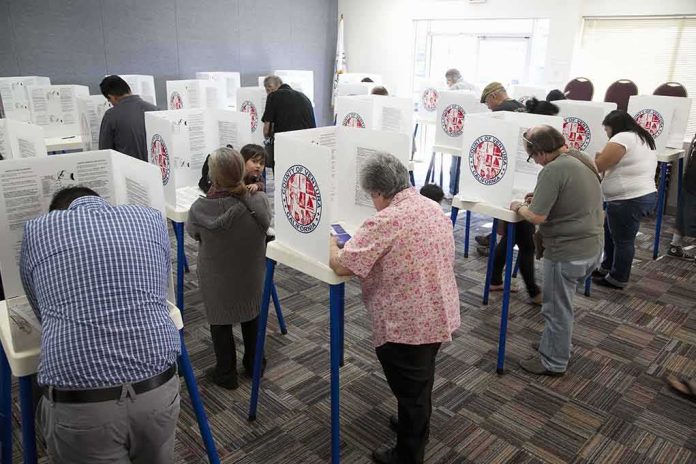
California’s top election officials are recruiting 16- and 17-year-old noncitizens with green cards to work inside polling places this November, raising new questions about safeguards and oversight.
Story Highlights
- State guidance invites high school students who are U.S. citizens or lawful permanent residents to serve as poll workers.
- A June outreach push from state leaders encouraged schools to supply teen workers meeting those criteria.
- County election offices echo the same standard and do not list undocumented teens as eligible.
- Critics say verification steps and public transparency remain unclear, fueling integrity concerns.
What California’s Rules Allow For Student Poll Workers
California’s official poll worker page says high school students may serve if they are at least 16, attend a public or private high school, maintain a 2.5 grade point average, and are either United States citizens or lawful permanent residents. The page gives counties a clear green light to recruit teens who meet those conditions. It does not mention undocumented students as eligible, and it makes citizenship optional for teens who have a green card.
State guidance reflects a change made years ago to widen the labor pool for Election Day. The policy opened the door to lawful permanent residents, who are not citizens and cannot vote, to still help run polling places. Supporters pitch this as civic education and language help where needed. Critics argue that inviting noncitizens into sensitive roles increases risk if background checks, training, and supervision are thin or uneven across counties.
Recent Outreach To Schools And How Counties Are Responding
The California Department of Education circulated guidance that repeats the same standard: student poll workers must be at least 16 and be United States citizens or lawful permanent residents in good standing at school. The letter frames the program as a way to “learn by doing” while supporting election administration. It does not expand eligibility beyond those two groups, and it keeps the grade point average floor in place.
County election offices mirror the state language in their own postings. Placer County’s student poll worker program lists the same eligibility requirements, including the option for lawful permanent residents alongside citizens. Contra Costa County also notes that noncitizens with permanent resident status may serve. These pages do not include any path for undocumented teens to work polls, matching Sacramento’s rules on paper.
Where Integrity Questions Persist For Voters
Conservatives ask a simple question: who checks the box, and who checks the checker? The state invites lawful permanent residents to help inside polling places, but it has not publicly laid out a uniform, statewide process that proves each teen’s citizenship or immigration status at hiring or training. Media and advocacy outlets debate the program, yet hard data on verification methods and audit results remain sparse in public view, leaving room for doubt.
Election officials and allied outlets say California is not recruiting undocumented immigrants and that the rules are clear. They argue expanding the worker pool helps solve staffing gaps and multilingual needs, especially in large counties. Still, trust depends on visible controls. Clear, posted procedures for document checks, chain-of-command at each site, and after-action audits would calm voters who worry about mistakes, mixed messaging, or quiet policy drift in a high-stakes year.
What Accountability Would Look Like Before November
State leaders can strengthen confidence with a few steps. First, publish a single, statewide checklist for student eligibility proof, including what documents are accepted and who verifies them. Second, require counties to log every verification and retain records for independent review. Third, release a summary audit after the election that shows how many student workers served, how many were citizens, how many were lawful permanent residents, and how many were rejected and why.
Parents and taxpayers also deserve clarity on roles. Teen workers should not handle tasks that control access or custody of ballots without close adult oversight. Counties should post site-level staffing plans that show who supervises teens and how conflicts are handled. When government chooses speed over clarity, trust falls. Clear proof beats talking points, and sunlight is the best guard against both error and agenda-driven spin—on the right or the left.
Sources:
thegatewaypundit.com, eac.gov, ajsocal.org, elections.sbcounty.gov, cde.ca.gov