
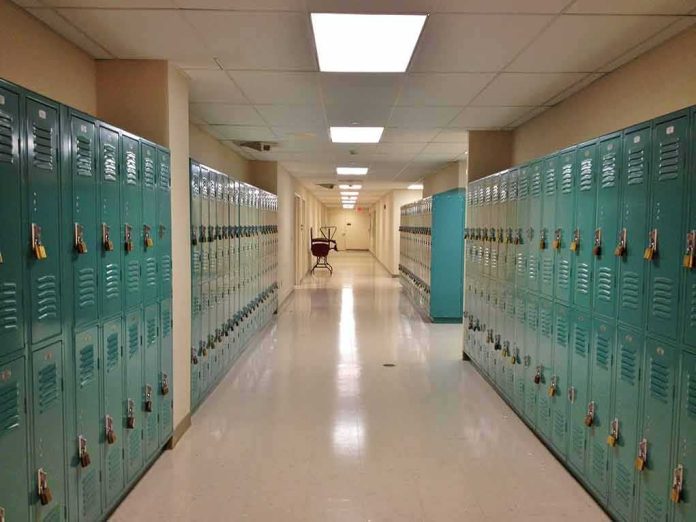
Students say they found a phone recording them in a school locker room—and police arrested their head coach the next day.
Story Snapshot
- Tracy Police say students found an actively recording phone in a boys’ locker room.
- Officers arrested Tracy High head football coach Jeffrey Pribble within 24 hours.
- School policies and court rulings treat locker rooms as high-privacy spaces.
- Police say the phone belonged to Pribble; the case now moves through the courts.
Police: Phone Found Recording, Coach Arrested
Tracy Police Department reported that students at Tracy High School discovered a cell phone recording them while they changed in a boys’ locker room on campus. The department said staff received the device, and officers identified the owner as head football coach Jeffrey Pribble, age 48. Police arrested Pribble the following day on suspicion of recording students in a private area. The department announced the arrest in a public news release and said the investigation remains active.
KCRA reported that students paused the recording, deleted the footage, and then turned the phone over to staff. Police said the device belonged to Pribble. Local outlets documented the arrest timeline and the alleged on-campus location. The broader facts across multiple reports match the police description, including where the phone was found and that an arrest occurred shortly after the discovery. Formal charges and court proceedings will determine criminal liability.
Why Locker Rooms Carry The Highest Privacy Protections
Courts treat locker rooms as places where people expect privacy over their bodies. A federal appeals court has ruled that video surveillance in school locker rooms violates the Fourth Amendment rights of students. The court said video monitoring in these spaces is inherently intrusive and unreasonable. That legal view drives school policies nationwide and shapes quick responses when any recording device appears in a changing area, whether a school camera or a personal phone.
School policy in Tracy Unified School District bans recording devices in ways that threaten student privacy. Guidance to California schools stresses that any student video surveillance must avoid private areas like locker rooms and restrooms. The message is simple: halls, yes; changing rooms, no. That line exists to protect students from exposure and to keep supervision focused on safety, not spying. When that line is crossed, schools notify police and move fast to protect students.
What Police And Parents Focus On Next
Police will work to establish what the device recorded, when, and how it was placed. Forensic work on the phone will matter: ownership, apps used, storage, and any deleted files that can be recovered. Investigators will interview students, staff, and coaches who had access to the locker room. Prosecutors will look at state voyeurism and child privacy laws that criminalize recording in changing spaces without consent. These statutes carry serious penalties because the harm is intimate and lasting.
🚦Tracy High School, CA
On Friday, September 12, 2026, the Tracy Police Department confirmed the arrest of Tracy High School Head Coach and Physical Education Teacher Jeffery Pribble, aged 48. According to a police press release, students discovered a cell phone recording them… pic.twitter.com/q9SVr7ryEQ— Matters of Accountability (@mattersofacct) September 14, 2026
Parents will demand immediate safeguards that do not wait on a verdict. Common-sense steps include controlled access to locker rooms, device sweeps before and after use, clear sign-in logs for adults, and a second adult present when students change. These are not burdens; they are basics. America’s conservative values stress parental authority, bodily privacy, and strict accountability when adults violate trust. Schools should meet that standard every day, not just after a scandal.
Accountability Without Panic
The arrest shows the system moved quickly: students spoke up, staff acted, and police made an arrest. That is how it should work. Yet speed must sit with clarity. Protect student privacy first, then build a careful case that can hold up in court. Leaders should communicate timelines, support services, and policy changes in plain language to families. Sunlight and steadiness build trust. If the facts prove the allegations, consequences should be swift and strong under the law.
Sources:
nypost.com, kcra.com, stocktonia.org, localnewsmatters.org, archive.org, abc7news.com, resources.finalsite.net, abc10.com, edweek.org, mason.gmu.edu