
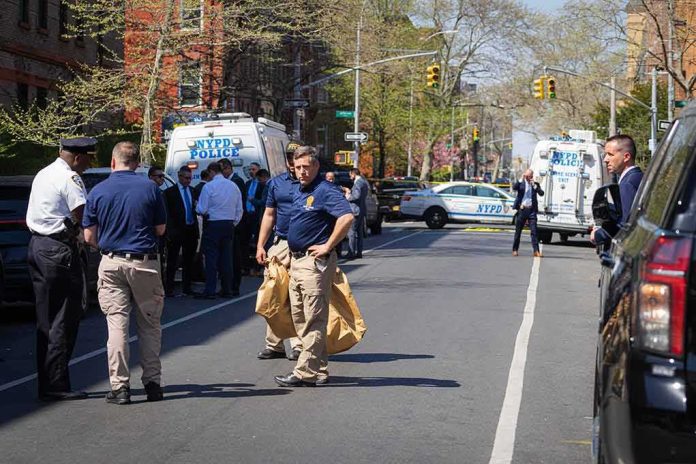
Two 911 calls about a screaming person in a white van set off a Belt Parkway stop that ended with the driver shot dead by New York City police.
At a Glance
- Two separate 911 callers reported a person screaming “Let me go” inside a white van.
- Officers stopped the van on the Belt Parkway; less-lethal tools failed, then shots were fired, police said.
- Police found an adult woman who had been in the van; she was not physically injured, officials said.
- The van allegedly rammed police and civilian cars before the shooting, according to the police account.
Two 911 Calls, A White Van, And A Race To A Brooklyn Highway
Police said two different 911 callers reported a person in distress just after 7 p.m. in Coney Island. One caller described a girl kicking and screaming inside a white van. Another caller reported hearing, “Let me go.” Patrol officers broadcast the van description and direction. Highway units spotted the van on the eastbound Belt Parkway near Coney Island Avenue and moved to stop it as traffic thinned and then stacked up along the route.
Officers boxed in the van and gave commands. Police said they broke the front passenger window when the driver did not comply. They used pepper spray and then a Taser when the driver kept the engine running. Officers reported the driver used the van to hit police and civilian cars while trying to force a way out. Gunfire followed when the van kept moving and officers believed bystanders faced a serious risk.
From Domestic Dispute To Deadly Stop
Detectives later found the woman who had been inside the van. Officials described her as an adult and said she was not physically hurt. Early reports said investigators believed the screaming may have come from a domestic dispute between the driver and the same woman, not a child abduction. That detail tracks with a police briefing that emphasized the real-time danger on the roadway over the original dispatch label of a kidnapping.
Medics rushed the driver to NYU Langone Hospital—Brooklyn, where he was pronounced dead. Officers were not shot or seriously hurt, according to initial accounts. The New York City Police Department’s Force Investigation Division took the case, as is standard after any police shooting that causes death. Highway lanes closed for hours overnight while investigators documented the scene and removed the battered vehicles.
Why Vehicles Change The Use-Of-Force Math
Courts have long treated a moving vehicle as a potential deadly weapon. When a suspect uses a car in a way that threatens people, officers can face seconds to decide. The United States Supreme Court has held that deadly force can be reasonable when officers believe a dangerous chase will continue and endanger others, even if shots risk the driver’s life. That principle sits at the center of stops like this one on a crowded city parkway.
Police training materials echo that logic. The Federal Law Enforcement Training Centers summarize the law this way: when facts lead a reasonable officer to think a suspect poses a significant threat of death or serious harm, deadly force may fall within the range of reasonableness. That bar is high, but it recognizes that a car pushing through a stop can turn a lane of traffic into a weapon in seconds.
What The Police Account Says, And What It Signals
The police account outlines a clear force ladder: verbal commands, window breach, pepper spray, Taser, then gunfire when the driver allegedly rammed vehicles. If body-worn camera footage reflects that order, it will support the claim that officers tried lesser force and fired only when the threat rose. That sequence also aligns with Supreme Court reasoning when a driver tries to break free after a stop and risks another dangerous pursuit on public roads.
🚨SHOCK FOOTAGE: NYPD officers fatally shot a 26-year-old kidnapping suspect on Saturday night in Brooklyn on the Belt Parkway near Coney Island Avenue after he rammed police cruisers and civilian vehicles while fleeing.
Police first used pepper spray and a Taser before opening… pic.twitter.com/DHi0C78XuD
— Moshe Schwartz (@YWNReporter) November 15, 2026
Labels in breaking news can mislead. The first calls said “kidnapping” and a “girl,” but police later found an adult woman and described a domestic dispute. What did not change was the on-site hazard described by officers: a boxed-in van, a driver ignoring commands, and impacts with cars around them. American conservative values stress protecting innocent people first. If the van became a weapon on a busy highway, stopping it fast was the duty call.
Sources:
thegatewaypundit.com, nytimes.com, fox5ny.com, nbcnewyork.com, brooklyn.news12.com, abc7ny.com