
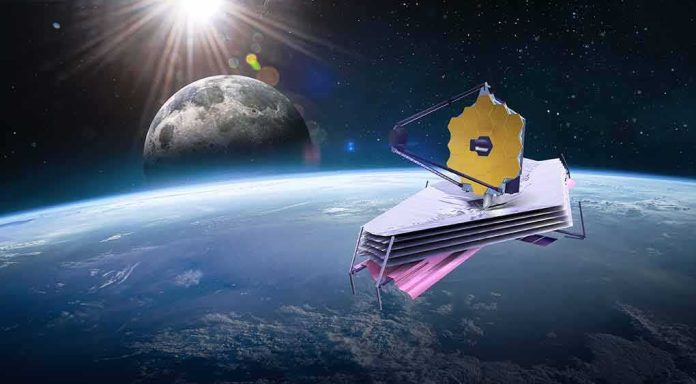
In the apparent chaos of the solar wind, Parker Solar Probe has uncovered a rule: the preferred “handedness” of turbulent magnetic rotations flips at small scales, marking the boundary where the Sun’s plasma stops behaving like a fluid and starts acting like a collection of particles.
At a Glance
- Parker Solar Probe’s in-situ measurements reveal a scale-dependent reversal in magnetic rotation sense in the near-Sun solar wind.
- Larger-scale turbulent fields rotate predominantly counterclockwise; at smaller, kinetic scales the preference switches to clockwise.
- The flip coincides with the transition from fluid-like (magnetohydrodynamic) to particle-governed (kinetic) plasma behavior.
- The feature strengthens and shifts to longer wavelengths with distance from the Sun, indicating organized radial evolution.
What Parker Actually Found: A Handedness Flip in Solar-Wind Turbulence
Turbulence in the solar wind has long been characterized statistically — power-law spectra, anisotropy, intermittency — but Parker Solar Probe (PSP) adds something qualitatively new: a preferred direction in how the magnetic-field vector rotates that reverses across scale. Using high-precision, in-situ measurements of magnetic fields and particles during close solar passes, the mission team reports that, when viewed radially outward from the Sun, turbulent fields tend to rotate counterclockwise at larger scales but switch to a clockwise preference at much smaller scales. This is not a momentary swirl; it is a persistent, scale-dependent signature embedded in the turbulence.
Critically, the reversal aligns with a physically meaningful boundary in plasma physics. At large scales, the solar wind behaves magnetohydrodynamically — like a conductive fluid guided by bulk field lines. At smaller scales, particle kinetics dominate: gyro-orbits, wave–particle interactions, and dispersive wave modes reshape dynamics. The reported flip straddles that interface, offering an observational tracer of where one regime yields to the other.
How the Spacecraft Could See It: Instruments, Geometry, and In-Situ Advantage
Parker’s advantage is proximity and instrumentation. Flying repeatedly inside 0.3 AU — and ultimately within a few solar radii — the spacecraft samples the nascent solar wind before its structures are smeared by expansion and mixing. The FIELDS instrument suite resolves rapid magnetic fluctuations and rotations in vector form, while particle instruments characterize the accompanying plasma state, allowing the team to connect rotation statistics to kinetic scales rather than infer them remotely. Earlier PSP campaigns established the mission’s ability to capture abrupt magnetic rotations — the so-called “switchbacks” — and to characterize turbulence and wave spectra across a broad frequency range, laying the groundwork for this more systematic handedness analysis.
The methodological core is straightforward in concept but demanding in execution: compute how the magnetic-field vector turns over time across a range of timescales (or equivalently, wavelengths), track the preferred sense of rotation, and follow how that preference evolves with heliocentric distance. The result is a clean sign change in rotation sense across a characteristic band, with the transition migrating toward longer wavelengths and growing in amplitude as the wind expands outward.
Why This Matters Physically: The MHD–Kinetic Interface, Named
The fluid-to-kinetic handoff governs how the Sun’s magnetic energy is redistributed and ultimately dissipated as heat — the central question behind coronal heating and solar-wind acceleration. A scale-dependent rotation preference is a proxy for magnetic helicity, the quantity that encodes twist and linkage of field lines. A sign flip in such rotation statistics implies different cascades or transfers on either side of the interface. At large scales, the preferred rotation is consistent with structures shaped by the Parker spiral and Alfvénic turbulence. At smaller, kinetic scales, particle effects and dispersive waves can invert the effective handedness of fluctuations, redirecting how energy and helicity move through the cascade.
This is not a one-off curiosity; handedness controls how fluctuations interact, which modes propagate or damp, and where dissipation lands. By tying the flip to a physically defined regime boundary, the observation constrains models that must decide which wave modes dominate, how cross-helicity evolves, and whether helicity transfers “forward” or undergoes nonlocal exchange between widely separated scales.
How It Fits the Record: From Theory and Near-Earth Hints to Near-Sun Proof
Hints of opposite helicity signs at different scales in the solar wind date back more than a decade in near-Earth observations, where negative helicity at large scales and positive at small scales were interpreted in light of the Parker spiral and turbulent diffusion effects. Parker’s contribution is to witness the phenomenon closer to the source and to watch it evolve radially, linking the sign change to the MHD–kinetic transition with direct particle and field measurements. That in-situ, near-Sun vantage resolves ambiguities that plague 1 AU datasets, where expansion, stream–stream interactions, and mixed origins smear distinct regimes.
PSP has already established a track record of turbulence and wave diagnostics between its inner passes and 1 AU, including distributions of cross-helicity, residual energy, and intermittency; these studies provided the spectral and statistical scaffolding upon which the present handedness result sits. The new observation therefore extends a documented pattern, but anchors it more firmly in the physics of the transition scale and its outward evolution.
Not a Switchback: Distinguishing Two Very Different “Reversals”
Language can mislead here. Parker’s early headliners were “switchbacks” — abrupt, transient reversals of the magnetic-field direction observed near perihelion. The handedness flip is different. Switchbacks are time-localized kinks in the field that momentarily tilt the flow; the handedness reversal is a statistical preference in how the field vector rotates across scales. One is a structural intermittency phenomenon; the other is a spectral–statistical signature tied to the turbulence cascade and kinetic transition. PSP’s ability to characterize both arises from the same vector-field fidelity, but they are distinct diagnostics with distinct implications.
Consequences and Uses: From Turbulence Closure to Space-Weather Transport
Why should forecasters or modelers care about which way a vector tends to turn? Because the sign and scale of rotation preference inform how fluctuations couple to particles, how energy is partitioned between protons and electrons, and how magnetic structures survive transport. If the handedness flip strengthens and shifts outward with distance, global models must represent a nonlocal, evolving cascade to move the right energy and helicity to the right scales at the right radii. That, in turn, sets boundary conditions for CME sheath turbulence, shock dissipation, and the diffusion coefficients that govern how solar energetic particles spread through interplanetary space.
Operational forecasts will not change overnight; the discovery refines the physics inside transport and turbulence closures rather than flipping a switch on tomorrow’s geomagnetic-storm prediction. But these are the kinds of constraints that compound: once embedded in transport models and validated against events, they improve the mapping from upstream conditions to magnetospheric impact. PSP’s progressive sampling of the inner heliosphere — complemented by Solar Orbiter and 1 AU monitors — is exactly the dataset pipeline needed to translate this signature into better parameterizations.
What To Watch Next: Scales, Radial Coverage, and Cross-Mission Tests
The next logical steps are empirical and comparative. Empirically, document the precise break scale of the handedness flip as a function of local plasma parameters — density, temperature, and magnetic-field strength — to test whether it tracks canonical kinetic scales such as the ion inertial length or gyroradius. Comparative work should align Parker intervals with Solar Orbiter and near-Earth spacecraft, probing whether the signature persists and how its break scale migrates with heliocentric distance and stream type. Finally, turbulence simulations that incorporate realistic expansion and kinetic physics can explore whether the observed nonlocal evolution of helicity and rotation preference emerges naturally under solar-wind conditions — a demanding but now testable target for theory.
Sources:
sciencedaily.com, nasa.gov, iopscience.iop.org, svs.gsfc.nasa.gov, phys.org, whatsnewpaper.com