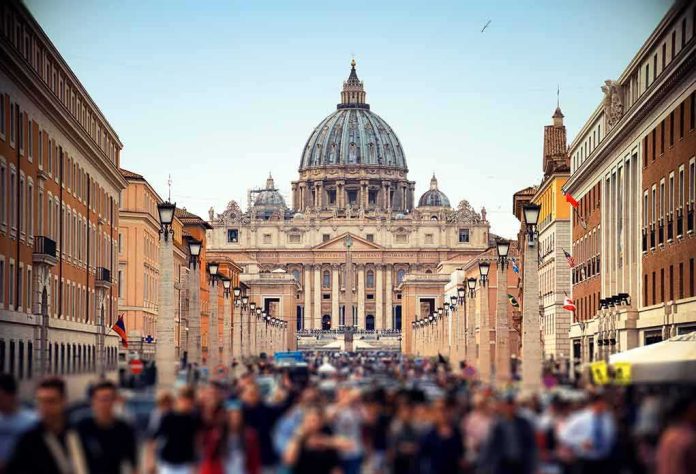
On a Saturday afternoon in late September, the Place de la Concorde—the square where the guillotine once stood during the Terror—filled with the largest religious crowd Paris has seen in a generation, as Pope Leo XIV celebrated an open-air Mass that organizers and the Vatican placed at roughly 600,000 to 800,000 people stretched down the Champs-Élysées.
Key Points
- Pope Leo XIV celebrated an open-air Mass at Place de la Concorde on September 26, 2026, the centerpiece of the first official papal visit to France in 18 years.
- Nearly 600,000 people pre-registered through the Diocese of Paris before the archdiocese closed sign-ups a week early; the Vatican and Reuters later put actual attendance at 700,000 to 800,000.
- The Mass followed a visit to Notre-Dame Cathedral, restored after its 2019 fire, and a speech to French officials urging protection of life against euthanasia, abortion, and surrogacy.
- Large outdoor crowd figures at papal events have historically varied by hundreds of thousands depending on measurement method, a pattern consistent with this gathering rather than a departure from it.
What Happened at Place de la Concorde
The Vatican’s official itinerary for the Apostolic Journey of Pope Leo XIV to France listed a single, unambiguous entry for the afternoon of September 26, 2026: “15:00 — Holy Mass at the Place de la Concorde.” That square, chosen for its symbolic weight and its capacity to absorb enormous crowds, sits at the foot of the Champs-Élysées, and by mid-afternoon the avenue itself had become an extension of the congregation. Reuters described crowds stretching the full length of the boulevard as Pope Leo urged the faithful to seek happiness in faith rather than material things, calling it the biggest single event of his four-day tour. The Mass drew on readings from Ezekiel and the Gospel of John centered on “living water,” with the pope invoking French saints and martyrs—Blandina, Irenaeus, Vincent de Paul—as models of endurance in faith.
Archbishop Laurent Ulrich of Paris, who greeted the pope, presented him with a restored image of the Blessed Virgin Mary reproduced from photographs after the original was lost in the 2019 Notre-Dame fire. The Mass followed a full day of engagements: a morning visit to the Maison Bakhita center for migrants and the socially marginalized, and, the previous evening, vespers inside the newly reopened Notre-Dame Cathedral, where Pope Leo venerated the relic of the Crown of Thorns before an assembly of roughly 45,000 clergy and religious from across France. Earlier still, he had met President Emmanuel Macron at the Élysée Palace and delivered a forceful address condemning assisted dying, abortion, and surrogacy as threats to the protection of life.
How the Crowd Figures Were Reached
The numbers attached to this Mass moved in a fairly narrow and well-documented band. Two weeks before the event, the Diocese of Paris announced it had reached “près de 600 000 inscrits”—nearly 600,000 registrants—and took the unusual step of closing its sign-up platform early, on the evening of September 16, because the volume had exceeded what organizers could comfortably manage. French authorities used that same figure, around 600,000, in their public planning estimates in the days leading up to the Mass. Registration, however, only counts those who signed up in advance; it does not capture the walk-up crowd that filled the surrounding streets on the day itself.
Once the Mass concluded, the Vatican’s own estimate came in higher than the registration count: roughly 700,000 people, by its account, exceeded the roughly 600,000 who had pre-registered. Reuters, reporting from the scene, cited an estimate of 800,000. That spread—600,000 registered, 700,000 to 800,000 estimated present—is not a contradiction so much as the ordinary gap between a sign-up list and an open-air crowd that anyone could join without a ticket, as several outlets noted people could still attempt to attend without having registered.
Why Crowd Numbers at Events Like This Always Carry a Range
Estimating attendance at a non-ticketed outdoor gathering is one of the oldest unsolved problems in public-event reporting, and it long predates this particular Mass. Crowd-science researchers generally agree that the most defensible method involves aerial imagery divided into zones of density, with a reasonable persons-per-square-foot figure applied to each zone and the totals summed. Even with that method, results vary widely depending on assumptions about density, and historical comparisons make the point vividly: estimates for Pope John Paul II’s 1979 Mass in Chicago’s Grant Park ranged across hundreds of thousands depending on who was counting and how. A 2015 Vatican-reported figure of 3.7 million for a papal gathering was likewise challenged by independent analysts who argued the true number was well under half that.
None of that history casts doubt on what happened in Paris—hundreds of thousands of people plainly filled the Place de la Concorde and the Champs-Élysées, a fact confirmed independently by the Vatican, the Diocese of Paris, French authorities, and multiple wire services covering the scene. It simply means that any headline figure attached to an open-air Mass—600,000, 700,000, 800,000—should be read as a serious, good-faith estimate rather than a census. The pattern holds across decades of papal travel: organizers and the church have institutional reasons to publicize scale, because visible turnout is treated, fairly or not, as a proxy for the vitality of Catholic practice in a given country. In France’s case, church officials framed the numbers alongside separate reports of a rising wave of adult converts and catechumens, using the Mass as evidence of renewed religious interest rather than an isolated spectacle.
Pope Leo XIV drew a record ~800,000 to a historic Paris Mass Saturday, the first papal visit to France in 18 years. He told young Catholics in French they are "today's church." Overflow sites opened as crowds packed the Champs-Élysées. #BreakingNews #PopeLeoXIV #France pic.twitter.com/p7k7s7xfPY
— Trending Updates Folders International (@trendingsources) September 26, 2026
What the Visit Signals Going Forward
This was the first official papal visit to France in eighteen years, and the choice of Paris—followed by stops at the Marian pilgrimage site of Lourdes—was deliberate: a pairing of the nation’s secular capital with one of Catholicism’s most enduring shrines. Whatever the precise attendance figure settles at in the historical record, the Mass at Place de la Concorde will be remembered less for its exact headcount than for what it represented: a test of whether a country long defined by its 1905 separation of church and state, and by decades of declining Mass attendance, could still summon a crowd of this magnitude for a single liturgical event. On that question, the answer from the Champs-Élysées was not ambiguous.
Sources:
humanevents.com, thetablet.co.uk, france24.com, euronews.com, osvnews.com, vaticannews.va, connexionfrance.com, afp.com, fullfact.org, newsinfo.inquirer.net, ijnet.org, whyy.org