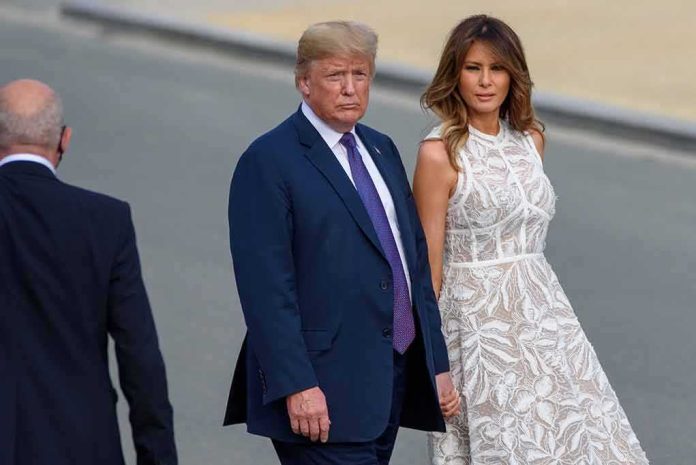
President Trump welcomed China’s Xi Jinping on the tarmac at Joint Base Andrews, a rare airport greeting that signaled high-stakes talks ahead.
Story Highlights
- Trump and First Lady Melania flew by Marine One to greet Xi at Joint Base Andrews.
- The White House announced the airport greeting in advance as part of a formal visit plan.
- Airport greetings by a president are uncommon and carry clear diplomatic signals.
- The formal state arrival at the White House was scheduled for the following day.
Trump Personally Greets Xi at Joint Base Andrews
President Trump and First Lady Melania Trump traveled from the White House to Joint Base Andrews to meet Chinese President Xi Jinping and his wife, Peng Liyuan, upon their arrival on September 23, 2026. A wire caption recorded Marine One landing for the greeting, with the visit marking Xi’s first trip to Washington in 11 years. Reporting placed Xi’s touchdown just after 5:30 p.m. Eastern time, with a military welcome and a long red carpet on the tarmac.
The greeting at the airfield matched what the White House laid out two days earlier. A briefing from the Office of the First Lady stated that the President would greet Xi and Peng at Joint Base Andrews on Wednesday, ahead of formal ceremonies the next day. Photo outlets and international wires also documented the Trumps boarding Marine One from the South Lawn and heading to the base for the arrival, reinforcing the timeline and purpose of the trip.
Protocol Signal: Uncommon Presidential Airport Welcome
Presidents rarely meet foreign leaders at the airport. Under normal practice, protocol officials or senior leaders meet dignitaries at Joint Base Andrews, while the White House hosts the main ceremony later. Outlets covering the visit described Trump’s presence on the tarmac as an uncommon and notable gesture, meant to set a tone for the talks to come. The move fit the event’s design: a high-visibility welcome before the formal state arrival at the White House.
Reports emphasized the ceremonial scale. Coverage described a lengthy red carpet, military honors, and a choreographed sequence as Xi exited his aircraft and greeted the American delegation. The optics underscored resolve and clarity. Trump’s team placed the United States front and center as host, while keeping the formal state reception for the following morning at the White House, consistent with the official schedule shared in advance.
What Comes Next: State Arrival and Policy Agenda
The White House outlined a full slate for Thursday, September 24, including a State Arrival Ceremony on the South Lawn and additional official events. The advance notice detailed the honor cordon and ceremonial elements that would mark the day’s proceedings. The airport greeting set the stage for policy talks that matter to American families and businesses, from trade and supply chains to national security and fair competition. The ceremony signaled that hard issues would be met with firm protocol and clear expectations.
President Donald J. Trump and First Lady Melania Trump greet President Xi Jinping of China and Madame Peng Liyuan upon their arrival in Washington, D.C., ahead of the state visit at the White House. pic.twitter.com/CUvFxU3xM4
— John F Kenndy (@JohnfKennedy218) September 24, 2026
Conservative readers should see two points here. First, the administration used ceremony to project strength at the start of a difficult conversation. Second, the airport greeting did not replace substance; it framed it. By greeting Xi at the plane, Trump made the host’s message unavoidable: America expects fair trade, secure borders, and respect for our rules. The formal state events would continue that message in a dignified setting, where talks can move from optics to outcomes.
Why the Tarmac Matters for America’s Leverage
Public ceremony can support private leverage. A rare presidential airport welcome tells allies and rivals that the United States is confident and in charge. The welcome also puts every camera on the American side of the field first. That matters when core interests are at stake for jobs, industry, technology, and national security. The schedule’s structure, previewed by the White House and then executed step by step, helped the administration set terms before the first closed-door meeting began.
Timeline Check: From South Lawn to the Andrews Red Carpet
Photo wires documented the Trumps departing the White House by helicopter on Wednesday to reach the base for Xi’s arrival. Coverage then captured the planeside welcome and the presence of senior military leadership at the tarmac ceremony. The White House preview, released earlier in the week, connected those moments with Thursday’s formal South Lawn ceremony, completing the two-day arc of protocol and policy preparation. These aligned reports form a clear, verifiable timeline for the events.
Bottom Line for Readers
Trump’s decision to greet Xi at the airport was not standard, but it was strategic. The move highlighted America’s position as host and set firm expectations before talks on issues that hit home: trade fairness, supply chain security, and national strength. The next day’s state ceremony at the White House would carry that message forward. The result was a visible show of order and purpose, backed by a schedule the White House laid out and then delivered on the ground.
Sources:
youtube.com, lusa.pt, washingtonexaminer.com, the-express.com, dallasexpress.com