
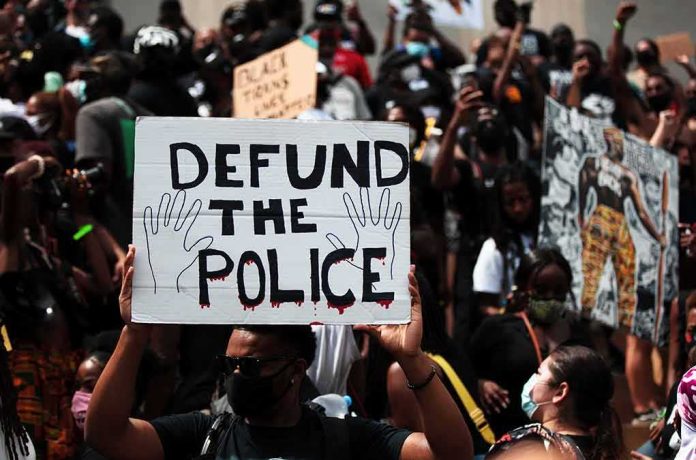
A city-sanctioned closure let a protest camp fortify a busy Madison intersection with nail-studded boards while residents and businesses waited for relief.
Story Snapshot
- City officials kept a key intersection closed with no set reopening date.
- Madison used salt trucks as barricades and added portable restrooms, drawing fire from critics.
- Protest organizers issued demands and signaled no end date yet.
- The mayor warned the scene is unsafe and not sustainable.
Encampment locks down a central block
City officials kept parts of Williamson Street and South Baldwin Street closed to vehicles “until further notice,” citing an ongoing public gathering at the site of the police shooting of Corey Ruiz. That decision froze a main artery for neighbors, commuters, and small shops. Residents reported blocked driveways and delivery detours, while foot traffic shifted around a maze of tents, pallets, and handmade barriers. The control of a busy city block with little contest from authorities heightened tension in the neighborhood.
Local coverage showed city salt trucks parked as barricades at the camp’s perimeter, replacing ad hoc trash cans and pallets that protesters first rolled into the street. Reporters also noted portable restrooms and city-run trash collection at the site. These steps reflect a playbook seen since 2020: keep crowds and cars separated, reduce sanitation risks, and maintain emergency access. But for taxpayers stuck in traffic and shop owners losing sales, those same steps felt like active help for an unlawful blockade.
City says safety; critics call it material support
Mayor Satya Rhodes-Conway said the current setup is not safe or sustainable and flagged public health and safety concerns, including too few bathrooms and limits on emergency access. That message ran alongside ongoing municipal measures that stabilized the camp’s day-to-day life. The result fueled the charge that the city blurred the line between managing risk and enabling occupation. The Milwaukee Journal Sentinel’s account described the city bolstering the encampment’s sufficiency with trash service, restrooms, and heavy trucks.
Protest organizers submitted demands to the city and declined to name an end date, pending talks. That stance, paired with a firm street closure and municipal services, set the stage for a drawn-out standoff. Neighborhood patience thinned as the days ticked by with no reopening timeline. Business owners and residents pressed officials to restore basic order and clear a path for deliveries, customers, and school and work commutes without delay.
Escalation risks rise with makeshift defenses
Images and reports of boards with nails lined at the encampment’s edge added a sharper edge to the dispute. The presence of makeshift hazards raises legal and moral stakes. It increases the chance a passerby, cyclist, or first responder gets hurt. Common sense says the city should not tolerate traps in a public right-of-way. The longer these items remain, the higher the odds of a bad outcome that neither protesters nor neighbors want.
Agitators in Madison Use Boards With Nails to Defend Their BLM Encampment, and the City Is Helping – Twitchy https://t.co/MqMXKIWQsb
— Not Enough Dogs (@DogsEnough) July 31, 2026
Law enforcement and fire crews adapted routes around the camp and responded to incidents nearby several times since the shooting, according to local reporting on agency statements. That improvisation can work for a few days. It does not scale across weeks. When detours and ad hoc barricades become the norm, response times suffer, and risk compounds. Every extra minute matters when someone’s house is on fire or a person can’t breathe.
What a responsible off-ramp looks like
City leaders can defend free speech while ending a street seizure. The first step is clarity: set a near-term date to reopen the intersection and publish a written plan that explains how, when, and who will do what. The next step is a lawful protest venue nearby with defined hours, clear safety rules, and sufficient sanitation. The final step is consistent enforcement. Warnings come first, then citations, then removal of hazards and illegal barricades. That track respects rights and restores order.
Critics are right to question city choices that keep a hard encampment alive on a public road. Free speech does not include the right to shut down a neighborhood indefinitely or plant hazards in the street. Officials argue they aimed to prevent clashes and keep services running. The facts show those steps also prolonged the blockade. The balance now tilts toward reopening the road, removing dangerous items, and moving talks into a forum that does not punish the people who live and work there.
Sources:
nypost.com, youtube.com, legalinsurrection.com, wpr.org, jsonline.com