
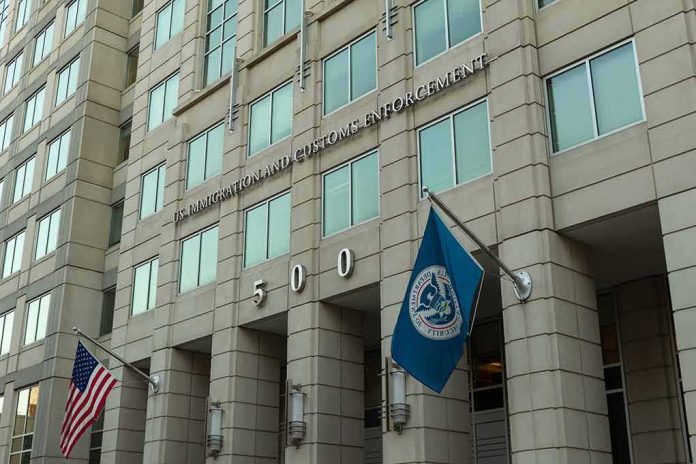
The hardest question in any immigration enforcement story isn’t whether agents showed up — that part is rarely in dispute. It’s what to call what they did once they left, and in Freeport, New York, that argument has become the whole story.
Key Points
- ICE has conducted repeated enforcement actions in and around Freeport since at least June 2025, confirmed independently by the Freeport village mayor.
- ICE describes these as “routine, daily targeted operations” against criminal aliens, fugitives, and re-entrants — not indiscriminate sweeps or checkpoints.
- Local residents, advocates, and some elected officials describe a different pattern on the ground: bus-stop staking, early-morning apartment checks, and racial profiling.
- The dispute reflects a nationwide, recurring divide over classification — “targeted operation” versus “sweep” — rather than a factual disagreement about whether arrests occurred.
- New York’s Attorney General has launched a portal for residents to submit photo and video documentation of ICE activity, institutionalizing the evidence gap at the center of these disputes.
What Actually Happened in Freeport
Freeport, a working-class village of roughly 43,000 people in Nassau County on Long Island’s South Shore, became one of several flashpoints in a broader wave of ICE activity across the New York metro area beginning in the spring of 2025. Coverage from News 12 confirms that both the Freeport village mayor and the neighboring Hempstead village mayor acknowledged ICE arrests in their communities, describing operations that included agents making arrests over consecutive days in the area. The Islip Forward sightings log, a crowdsourced community tracker, records specific incidents in Freeport — agents taking an individual into custody on Babylon Turnpike, and a detention outside a Roosevelt deli just blocks away — dated to early July.
The Long Island Herald’s reporting places the start of the visible pattern in early June, describing what a local advocate characterized as agents targeting “hardworking mom and pops, neighbors and students rather than criminals,” with tactics including staking out bus stops and conducting checks inside apartment complexes. By August, Nassau County lawmakers were telling Patch that ICE activity had escalated further across the county, with Freeport specifically named as a site of continued operations. None of this is seriously contested; the presence of federal agents making arrests in Freeport across multiple months in 2025 is corroborated by local officials, community trackers, and regional press covering the same underlying events from different vantage points.
How ICE Frames Its Own Operations
ICE’s public position, laid out in its own fact sheets on New York-area enforcement, is specific and consistent: the agency says it conducts “routine, daily targeted operations” built around lists of immigration fugitives, prior deportees who re-entered the country illegally, and “criminal aliens” — a term ICE uses for noncitizens with criminal convictions or pending charges. The agency states flatly that it “does not conduct sweeps, checkpoints or raids that target aliens indiscriminately.” This is not a throwaway line; it’s the agency’s legal and operational self-definition, and it matters because it draws a bright distinction between individualized enforcement against people already flagged in federal databases and the kind of dragnet action that critics allege is happening on the ground.
The scale of ICE’s stated New York-area activity in 2025 backs up the claim that operations are numerically large without necessarily being indiscriminate. A single week’s fugitive operation yielded 41 arrests across the five boroughs and surrounding areas. An April enhanced operation focused on “egregious criminal alien offenders” produced 206 arrests in and around New York City. A five-day operation ending September 25 brought in more than 80 arrests across New York City, the Hudson Valley, and Long Island. On Long Island specifically, ICE has told reporters its agents have detained more than 1,600 people, the large majority with prior convictions. Separately, Nassau County law enforcement, working alongside ICE, conducted gang-focused takedowns netting dozens of alleged Bloods, Crips, MS-13, and Trinitarios members, several of whom already carried existing ICE removal orders.
Where the Genuine Disagreement Lies
The friction isn’t over whether people were arrested — it’s over who they were and how they were found. ICE’s own assistant field office director for Long Island, in an on-camera interview, described the agency’s target population as people who “violate immigration laws and pose threats to public safety or national security,” citing a specific case of a man who allegedly stabbed a nurse and was released by a court, later apprehended by ICE. He also acknowledged the agency weighs humanitarian factors — medical conditions, sole caregiving responsibilities — before acting, and conceded that “mistaken arrests” do occur within the operational tempo of daily enforcement.
Advocates and immigration attorneys tell a different version of the same landscape. One attorney representing detained Long Island residents, including two teenage brothers and a mother held for six months in a Houston facility, described inadequate detention conditions and characterized public messaging around the operations as a “propaganda project to dehumanize immigrants.” Local reporting from Freeport echoes this: residents describe fear driven by what they perceive as indiscriminate tactics — surveillance near transit stops, unannounced building checks — rather than the individualized, database-driven targeting ICE describes. A U.S. citizen stopped and searched during a Long Island traffic encounter, captured on video, has become a touchstone example for those arguing that “targeted” operations routinely catch bystanders who were never on any list.
The Broader Pattern This Fits
Freeport is not an isolated episode; it’s one data point in a running national argument that resurfaces every time ICE intensifies activity in a dense, immigrant-heavy metro area. The same script played out on Manhattan’s Canal Street in October 2025, when a Homeland Security Investigations operation targeting counterfeit-goods vendors drew protests and confrontations, prompting New York City Hall and lawmakers to publicly demand an accounting from federal authorities even after ICE confirmed nine arrests and characterized the action as “targeted, intelligence-driven.” It played out again in Riverhead, in Hudson Valley towns, and across Queens, where warnings from federal border officials preceded operations that community groups say swept up people well beyond the stated target list. The pattern is durable because both sides are, in a narrow sense, telling the truth about their own vantage point: ICE is executing against real target lists with real criminal histories attached to many arrestees, while community observers are documenting real instances of fear, profiling allegations, and collateral encounters that fall outside any formal target.
ICE agents were spotted TAKING DOWN multiple illegal immigrants in Freeport, New York..
Absolutely LOVE this. 👏👏 pic.twitter.com/K4vnSBiW3D
— THE17thLetter (@The17thIatter) July 31, 2026
What It Means Going Forward
New York State’s response has been to formalize documentation rather than simply litigate the dispute in press statements. Attorney General Letitia James launched a public portal specifically to collect photo and video evidence of ICE activity from residents, an institutional acknowledgment that the evidentiary record — who agents approached, how, and on what basis — has been thin and contested. For Freeport and comparable Long Island communities, that means the practical stakes of this argument will keep landing on ordinary residents: know that ICE agents are not police officers even when their gear suggests otherwise, that agents generally need a judicial warrant to enter a private home without consent, and that legal aid hotlines exist precisely because the gap between “targeted operation” and “indiscriminate sweep” is where real people currently live.
Sources:
youtube.com, ice.gov, bronx.news12.com, theweek.in, military.com, patch.com, thehill.com, islipforward.org, inkl.com