
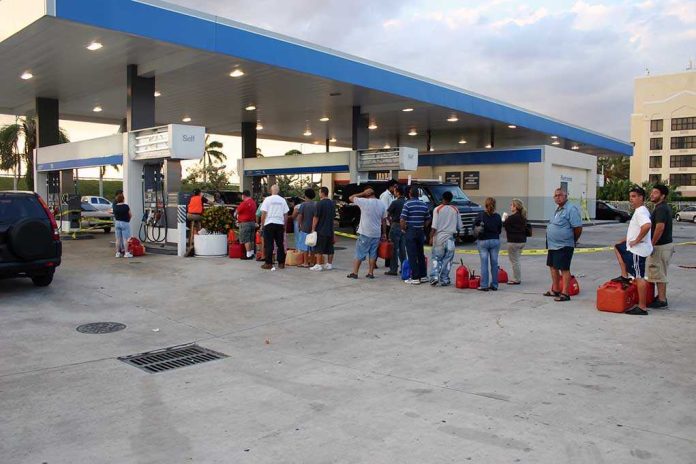
Gasoline reserves across the United States are sliding toward “unheard-of” lows, shrinking the safety buffer that keeps prices – and daily life – from spiraling when something goes wrong.
Story Snapshot
- Gasoline stockpiles have fallen for weeks and sit well below normal levels for this time of year.
- Major banks and federal data warn inventories could hit the lowest late‑summer levels in modern records.
- Analysts say the main risk is higher prices and more volatility, not empty pumps everywhere.
- Many Americans see these record drawdowns as one more sign that leaders are failing to protect basic economic stability.
Gasoline inventories are falling at record speed
Energy Information Administration data show United States gasoline stocks have been dropping week after week as driving demand rises and imports lag. Reuters reported 15 straight weeks of inventory declines since mid‑February, taking national gasoline supplies down from over 253 million barrels to about 211.5 million barrels, roughly 5.5% below the five‑year average for this time of year. Forbes noted this February‑to‑May drawdown, about 47.5 million barrels, is the steepest on record going back to 1990. Together, these reports describe a fuel system that is not empty, but clearly “losing its buffer” as the busy summer season unfolds.
Trading Economics, using Energy Information Administration figures, recently recorded a single‑week drop of about 2.3 million barrels in gasoline stocks, far larger than analysts expected. Other weeks have seen similar declines as refineries struggle to keep up with strong demand and shifting crude supplies. Analysts say this pattern matters because inventories serve as the shock absorber for the fuel system; when that cushion shrinks, any new disruption – a refinery outage, a storm, or a foreign crisis – can push prices up much faster than normal. Drivers do not yet face mass station closures, but the margin for error is clearly thinning.
Historic seasonal lows now in sight
Morgan Stanley warned in a May research note, reported by Reuters, that United States gasoline inventories could fall to around 198 million barrels by the end of August. Trade press coverage of the same forecast highlighted that this would be below the low point seen during the 2022 energy crisis and would mark the lowest late‑summer level in modern records. As of late April, total gasoline inventories stood near 222 million barrels, already the lowest for that time of year since 2014. In a more severe scenario where supply problems continue, Morgan Stanley estimated stockpiles could sink toward 190 million barrels, a level not seen since October 2012. These projections have fueled concern among market watchers and ordinary drivers alike.
Past data show that low gasoline inventories do happen, but today’s drawdown is unusually fast and broad. Energy Information Administration figures from a prior episode showed stocks at about 205 million barrels in early November, the lowest level in 12 years and more than 8 million barrels under the five‑year average. A separate analysis on professional networks pointed out that mid‑November gasoline stocks near 207 million barrels, while low, did not cause a wave of shortages at the pump. The current situation is different mainly because the declines are happening earlier in the year, just as summer trips and freight demand peak, and because they are layered on top of other stresses in the oil market.
Tight fuel markets, higher prices, and public frustration
Most analysts stress a key distinction: low gasoline inventories signal a tight market and likely higher prices, not an immediate nationwide fuel shortage. Forbes argued that today’s stock levels, by themselves, are “not alarming,” but the rapid pace of decline shows the system using reserves much faster than normal as summer driving starts. Yahoo Finance, citing ConsumerAffairs and Forbes, described gasoline stockpiles as “nearing unheard‑of lows” yet still adequate for daily needs, while warning of more price spikes if another shock hits. That kind of language – tight but not yet broken – explains why some experts urge calm even as others sound the alarm.
🛢 The wars in Ukraine and the Persian Gulf are driving a crisis in the gasoline and diesel market, Reuters reports.
The agency notes that gasoline and diesel stockpiles are at multi-year lows, refining margins have hit record highs, and refinery throughput in key production…
— NZAWAKEN4PEACE (@beakiwisfirst) July 21, 2026
For many Americans, especially older conservatives and liberals who already feel squeezed, this story reinforces a broader worry: basic energy security no longer feels like a given. Marketplace reported that overall United States petroleum inventories have dropped to their lowest levels since 2004, while the Strategic Petroleum Reserve has fallen to its weakest point since 1983. Those numbers make it hard for citizens to believe anyone in Washington, from President Trump’s administration to Congress and the permanent bureaucracy, is truly safeguarding the energy lifelines that power work, food delivery, and family life. When gasoline stocks slide and emergency reserves shrink, it looks like yet another case where elites play geopolitical games while ordinary people brace for pain at the pump.
Sources:
reuters.com, tradingeconomics.com, finance.yahoo.com, boereport.com, ttnews.com, theglobeandmail.com, foxbusiness.com, linkedin.com