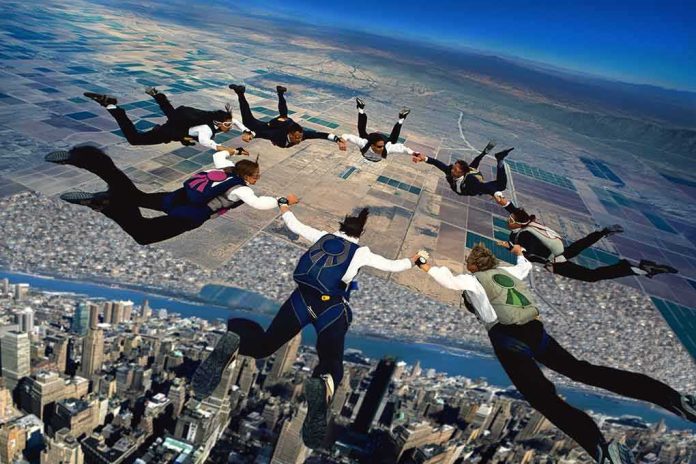
A British skydiver fell roughly 10,000 feet after being knocked out mid-air and lived to tell the tale.
Story Highlights
- Holly Wiffen, 35, was knocked unconscious during a group jump over Langar airfield and survived the fall.
- Reports say a tall conifer tree slowed her impact; she suffered a broken leg and a fractured spine.
- Wiffen later recalled waking on the ground and seeing her reserve parachute in a tree.
- The episode comes as skydiving remains statistically low-risk, with very few fatalities per 100,000 jumps.
Unconscious Freefall Over Nottinghamshire
British skydiver Holly Wiffen, age 35, was taking part in a group jump above Langar airfield near Nottingham, England, on August 7 when a mid-air collision reportedly knocked her unconscious. Accounts say she fell about 10,000 to 12,000 feet before landing near trees at the drop zone. Several outlets identify Wiffen as an experienced hobbyist with more than 400 prior jumps at the time of the accident. The fall left her severely injured but alive, in a case that stunned even seasoned jumpers.
Reports describe a dramatic scene as fellow skydivers and staff rushed to help after impact. After regaining consciousness on the ground, Wiffen said she saw her reserve parachute hanging in a tree and realized something had gone wrong during descent. Her first words, she recalled, were about removing her gear before paramedics cut it off. Emergency responders stabilized her and transported her for treatment, according to local coverage of the incident near Langar.
Tree Impact Likely Slowed the Descent
Coverage from British and international outlets credits a tall conifer tree with slowing Wiffen’s final drop, likely reducing the force of impact enough to save her life. She suffered a broken leg and a fractured spine or vertebrae, injuries that match a high-energy fall mitigated late in the descent. Reports vary on the exact altitude and parachute sequence, but all agree the tree contact was a key factor in the survivable landing that followed the mid-air knockout.
Accounts differ slightly on whether, and how, any canopy deployed near the end of the fall, a detail that is common to early reporting in rare survival events. One broadcast captured Wiffen’s own recollection after the incident, including her memory of waking on the ground and noticing the reserve parachute snagged in a tree nearby. That detail tracks with multiple reports that emphasize the role of the conifer in slowing her descent just before impact.
Safety Context: Rare Event in a Low-Risk Sport
The United States Parachute Association reported 3.88 million skydives in 2024 with nine fatalities, a rate of 0.23 per 100,000 jumps, underscoring that modern skydiving is statistically very safe. Many serious outcomes stem from deployment or low-altitude issues, not routine freefall, which helps explain why specialized gear and training focus on canopy and reserve procedures. Wiffen’s survival illustrates how late-stage factors—trees, terrain features, or partial canopy events—can heavily influence outcomes in extreme cases.
WATCH: Skydiver survives terrifying 10,000ft PLUNGE UNCONSCIOUS — The Sun
Holly Wiffen was struck in the head by another jumper, sending her into an uncontrolled fall
She eventually deployed her chute & escaped with a shattered leg & spinal fractures after crashing into a tree pic.twitter.com/eO0jRcR6qQ
— RTVisual (@RT_Visual_on_X) September 7, 2026
Wiffen’s reported experience level, cited at 425 jumps, places her well beyond a novice tier, though even skilled skydivers can face unpredictable mid-air contact in group formations. The incident’s key takeaways align with long-standing safety themes: strong formation discipline, altitude awareness, and redundancy through reserve systems and emergency protocols. While the exact gear sequence remains described differently across outlets, the central facts are clear: a collision, a long fall, a tree-assisted slowdown, and a hard but survivable landing.
Sources:
thenightly.com.au, telegraph.co.uk, dailymail.com, westbridgfordwire.com, youtube.com, eldebate.com, x.com