
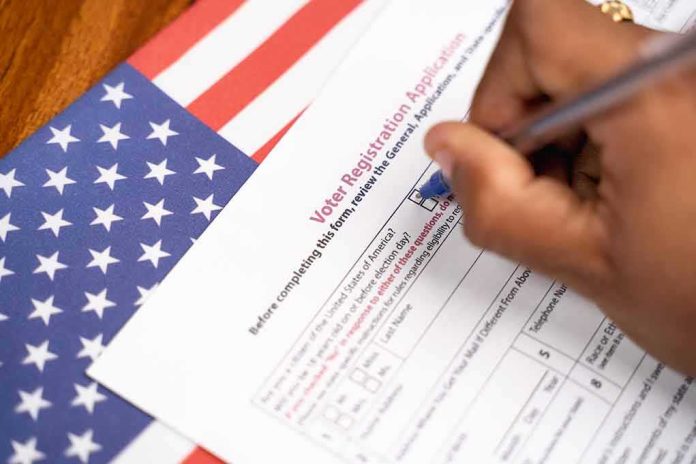
California lets people register to vote without a driver’s license or Social Security number, then assigns a state-made ID to validate the file.
Story Snapshot
- California allows registration with no driver’s license or Social Security number; officials assign a unique voter identifier.
- Most voters do not show ID at the polls; only certain first-time voters face an ID check.
- Acceptable ID for those first-time checks can be a utility bill or a government document, not just photo ID.
- State rules rely on later database matching and county review rather than front-end document proof.
What California Actually Requires To Register
California’s registration form asks for a driver’s license, state identification number, or the last four digits of a Social Security number. The Secretary of State says that if an applicant has none of these, the person can still register, and will be assigned a unique identifier for voter records. County officials then process the application and attach the voter’s signature to the record. This workflow follows state regulations that contemplate missing numbers and provide an alternate state-issued identifier.
The state’s regulations tie the file to other data checks. If an applicant provides a driver’s license or state identification number, the system attempts a match with the Department of Motor Vehicles on name and date of birth. If the person provides Social Security digits, the system attempts a match with Social Security Administration records. If neither number exists, the system creates the unique identifier and tracks that status in the statewide database.
What Happens At The Polls
Most California voters are not asked to show identification when they vote in person. That is the state’s own guidance and is widely summarized as a “no ID required” rule for routine voters. One specific group may face an ID request. If a person registered by mail and did not provide a driver’s license, state identification number, or the last four digits of a Social Security number, a poll worker may ask for identification the first time that person votes.
California lists a broad set of acceptable documents for that narrow first-time check. A current and valid photo ID works. But the voter can also show a copy of a recent utility bill, the county’s sample ballot booklet, a passport, a driver license, a state ID, a student ID, or another document sent by a government agency. Critics argue this list is too loose for proving identity. Supporters answer that it meets federal Help America Vote Act standards and avoids blocking eligible voters over paperwork hurdles.
The Integrity Debate: Process Trust Versus Proof At Point Of Service
The core policy fight is not whether California verifies voters, but when and how. The state leans on database matching and county review at registration, then limits in-person ID checks to a targeted first-time scenario. That design shifts the burden of verification to the back office instead of the front counter. Advocates say this protects access and still deters fraud. Skeptics say a system that often does not ask for ID at the polling place invites error and weakens public trust.
In Nevada, a voter ID citizen initiative passed 73%–27% in 2024. Nevada requires constitutional amendments to win two successive general elections, so it is on the 2026 ballot again. If it passes a second time, Nevada leaves the no-ID list. 14 states plus DC are on that list.…
— Terry Agar (@Tassas22) September 2, 2026
American conservative values prioritize equal access and equal protection, which includes clean rolls and simple, uniform rules. On that measure, California’s approach strains common sense. A process that allows blank ID fields at registration, assigns a government number later, and then rarely asks for ID at the polls, places heavy faith in databases and clerical accuracy. That may work most of the time, but it does little to answer the voter who wants a clear, visible safeguard when a ballot is issued.
How To Read The “400,000 Without ID” Frame
The claim points to a real rule: people without a driver’s license or Social Security number can still register and receive a unique identifier. The number itself needs official confirmation from statewide data, which the public sources here do not provide. The documented facts show permissive front-end rules and rare in-person ID checks, not a count of affected voters. The practical question remains obvious: Should California move more of its checks to the point of service, where the voter presents a government ID, or keep the checks behind the scenes?
What Would Tighten Confidence Without Blocking Voters
Two changes would align with common-sense expectations while keeping ballots accessible. First, require a government-issued ID at the polls and the last four Social Security digits for vote-by-mail, with a free ID option to remove cost barriers. Second, publish clear statewide statistics on how many registrations get a unique identifier, how many fail Department of Motor Vehicles or Social Security matches, and how those cases are resolved. Sunlight and simple rules calm doubts better than slogans.
Sources:
thegatewaypundit.com, sos.ca.gov, elections.cdn.sos.ca.gov, voteriders.org, ballotpedia.org