One middle-of-the-night airstrike in a remote Nigerian border town just forced Americans to confront a blunt question: how far should the United States go to hunt terrorists that most voters have never heard of.
Story Snapshot
- Trump says U.S. and Nigerian forces killed Abu-Bilal al-Minuki, described as the Islamic State group’s global number two [1]
- Nigerian commanders detail a tightly choreographed night raid near Lake Chad with jets, ground troops, and special forces
- Analysts dispute whether al-Minuki truly ranked as “second in command globally,” or as a powerful regional boss [2]
- The strike spotlights a bigger fight: can killing one leader really diminish a global jihadist network, or just shift the battlefield
The night a secret war flickered into public view
Donald Trump did not break this news in the Oval Office; he did it with a late-night blast on his social platform that ricocheted across television and phones before most people even knew the name Abu-Bilal al-Minuki. Trump said that, at his direction, American forces working with Nigeria had executed a “meticulously planned and very complex mission” in Africa, killing the man he called the “second in command of the militant group Islamic State globally.” [1] The White House framed it as a clean win: the world’s “most active terrorist” erased, Christians and Americans safer, mission accomplished.
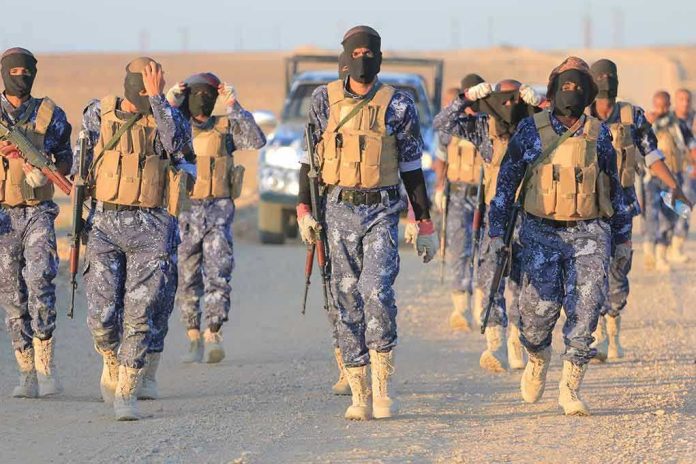
Across the Atlantic, Nigerian officers from Operation Hadin Kai filled in the military details that Washington left vague. Their account described an overnight assault on a compound in Metele, Borno State, beginning just after midnight and wrapping before dawn. Nigerian jets hit first with precision air strikes, then ground troops and special forces moved in, having already blocked likely escape routes around the Lake Chad Basin. Initial battlefield assessments said al-Minuki and several lieutenants died on site. On paper, this looked like textbook joint warfare: American intelligence and air power, Nigerian boots, one shared target.
Did the joint strike really eliminate ISIS’s global number two
Supporters of the operation anchor their confidence in two claims: that the right man was killed, and that his removal genuinely damaged the Islamic State group. Trump’s announcement, echoed by American-friendly outlets, portrays al-Minuki as an architect of hostage taking, financing, and attack planning across continents, and notes that he already sat on a United States sanctions list as a “specially designated global terrorist,” a status recorded in the Federal Register in 2023. Nigerian reporting adds aliases that match earlier intelligence, helping tie the corpse in Borno to the name in Washington’s files.
Yet counterterrorism specialists reading the same tea leaves urge more caution than the triumphant tone suggests. The Long War Journal, drawing on a United Nations monitoring report, describes al-Minuki as head of the group’s Al Furqan office, a powerful post but one step removed from the core caliphate leadership that directs global strategy. [2] The difference matters. Calling someone “ISIS number two” sounds decisive in a campaign speech, but the public evidence so far looks more like a senior regional commander whose influence radiated from the Lake Chad Basin rather than from the group’s central hub.
Proof, propaganda, and the conservative problem of trust
Americans who lived through years of shifting stories in Iraq and Afghanistan have every right to ask what proof exists beyond official press lines. The current public record leans heavily on a presidential post and quick media summaries. None of the released material includes biometric confirmation, DNA reports, or a declassified after-action review demonstrating that the body matched the sanctions file, that communications from his phones stopped, or that financial flows he allegedly managed went dark. [1][2] That does not mean the claim is false; it means the government is asking citizens to “just trust us” one more time.
Common-sense conservative instincts recoil at that posture. A limited, constitutional foreign policy rests on transparency to the extent operational security allows and on Congress having the facts, not on personality-driven narratives. The Nigerian side has at least put named units and a specific location on the record. Washington, by contrast, has relied primarily on Trump’s dramatic framing, even as the military quietly continues air operations elsewhere in the region. Without more hard evidence, citizens end up adjudicating truth along partisan lines instead of weighing verifiable facts, which serves political careers but not national security.
What this strike really tells us about modern counterterror wars
The operation against al-Minuki fits a now-familiar pattern. A joint task force tracks a figure for months; jets and drones hit a safe house in the dark; special operators sweep the ruins; a president informs the world that a “mastermind” is gone; and cable shows loop the same video clips while analysts debate whether the target was truly irreplaceable. Here, Trump and Nigerian commanders say the strike will “greatly diminish” Islamic State operations, yet none of the public documents show how the network will actually fracture without al-Minuki. [2]
💥 BREAKING: AFRICOM confirms airstrike kills Abu-Bilal al-Minuki, ISIS deputy in Nigeria. Major blow to terror network, but retaliation fears loom. Oil & security risks in focus. pic.twitter.com/ikzbC5qSL7
— Dino breaking news (@DinoLeadingNews) May 16, 2026
Conservatives who take security seriously but reject open-ended wars should read this event as both success and warning. Success because a hostile commander who ordered attacks on civilians now faces a justice more final than any courtroom. Warning because the United States once again acted in a shadow zone—air power, intelligence, and lethal authority projected into another sovereign state, followed by a political victory lap and thin documentation. Al-Minuki may indeed be dead and his faction rattled. The harder question is whether Washington and its allies will ever show enough of the evidence for citizens to judge future strikes by something sturdier than applause lines.
Sources:
[1] YouTube – US President Trump Announces ISIS Deputy Abu-Bilal al …
[2] YouTube – Top ISIS Commander, Abu-Bilal Al-minuki Killed In U.S-Nigeria Joint …