
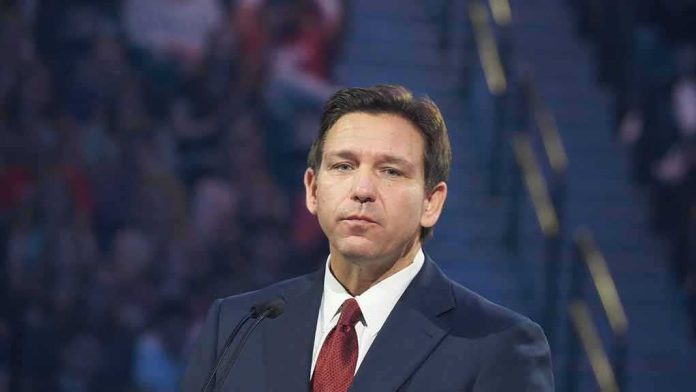
A political book is rarely just a book: it is a biography written on the author’s own terms, a policy platform without the scrutiny of a press conference, and — for a certain class of ambitious officeholder — a quiet way of keeping a national conversation alive while out of office or between campaigns. That is the lens through which to read the news that Florida Governor Ron DeSantis is working on a new manuscript.
Key Points
- Axios reported on November 22, 2026, that two sources familiar with the project say DeSantis is quietly writing a book, a claim quickly reproduced by Mediaite and other outlets.
- DeSantis has published two prior books — Dreams from Our Founding Fathers (2011) and The Courage to Be Free (2023) — making a third project consistent with his established practice.
- The timing coincides with the end of his second term as Florida’s term-limited governor, giving the project a natural platform-building function regardless of his future plans.
- DeSantis has not publicly confirmed the project, and his office did not respond to requests for comment, leaving the book’s content, title, and publisher undisclosed.
- The project’s connection to a potential 2028 presidential run is, by the reporting’s own framing, speculation rather than a confirmed campaign signal.
What Axios Reported, and Why It Spread Fast
The story originated with Axios reporter Alex Isenstadt, who wrote that two sources familiar with the matter say DeSantis is quietly working on a book. Mediaite reproduced the account within a day, under a headline that paired the book claim directly with 2028 speculation. Within hours, the same two-source framing had rippled across Political Wire, AOL, and aggregation services, each repeating the Axios sourcing rather than adding independent reporting of their own. That is a familiar rhythm in Washington journalism: one outlet breaks a story built on anonymous access, and the rest of the press ecosystem amplifies it immediately, which creates an impression of broad confirmation even when the underlying evidence has not expanded.
It is worth being precise about what is and is not established here. Axios attributes the claim to two sources, not to a signed contract, a publisher’s catalog listing, or a statement from DeSantis himself; Mediaite notes that his spokespeople did not respond to requests for comment. That is a normal condition for early reporting on a project still in development — publishers routinely keep manuscripts confidential until a release date nears — and it does not undercut the reporting’s core claim, which rests on named journalistic sourcing standards rather than documentary proof.
A Governor With a Track Record of Writing His Own Books
DeSantis is not approaching this project cold. His 2011 book, Dreams from Our Founding Fathers, argued for a return to constitutional originalism years before he held statewide office, and The Courage to Be Free, published in 2023 just ahead of his presidential run, functioned explicitly as a campaign document laying out his record as governor and his vision for the party. Social commentary circulating around this latest report has noted that DeSantis is known for writing his own material rather than relying on a ghostwriter, which — if accurate to form — would mean any new manuscript reflects his direct voice rather than a staff-polished message, a detail that matters to readers assessing how seriously to weigh its political content.
That history is the strongest evidence that the current report is plausible on its face: a politician who has written two books timed to political inflection points is statistically likely to write a third at the next one. It does not, however, establish what this specific book contains, when it will appear, or who will publish it — details the current reporting does not provide.
Why the Timing Reads as Significant
DeSantis is barred by Florida law from seeking a third consecutive term, and reporting places his departure from the governor’s mansion around January 2027. Political Wire frames the book as a potential vehicle for a term-limited governor to articulate where he believes the Republican Party should head next. That is a reasonable inference grounded in how outgoing officeholders have used books before: a text gives a departing governor a reason to tour, to grant interviews, to appear on podcasts and cable panels, and to remain part of the national conversation at precisely the moment his formal office stops generating daily headlines. None of that requires a campaign decision to already exist — it only requires an instinct for political relevance, which DeSantis has demonstrated throughout his career.
Departing Florida Gov. Ron DeSantis is allegedly working on a new book, fueling speculation about a potential 2028 presidential run. https://t.co/yLr0JLvidT
— OK! Magazine USA (@OKMagazine) November 24, 2026
The Long Lineage of the Campaign Book
Pairing a book with speculation about higher office is not a new phenomenon invented by cable news aggregation; it is one of the oldest patterns in American political communication. Thomas Jefferson’s Notes on the State of Virginia became a flashpoint in the election of 1800, and the genre has run continuously through Abraham Lincoln’s collected writings, Richard Nixon’s Six Crises, Jimmy Carter’s Why Not the Best?, and Barack Obama’s The Audacity of Hope. Dwight Eisenhower published Crusade in Europe four years before his election while publicly disclaiming any interest in the presidency — a reminder that a book’s existence tells you little on its own about its author’s intentions. The pattern is instructive precisely because it cuts both ways: some campaign-adjacent books precede a run by years, and some political memoirs are written by people who never run again. A book is evidence of ambition in the general sense — the desire to shape a party’s direction — but it is not proof of a specific electoral decision.
What the Evidence Actually Supports
Strip away the speculation and the verifiable core is narrow but solid: a well-regarded national outlet, relying on two sources, reports that a sitting governor with a documented history of authorship is writing again, at a moment when his public career is entering a new phase. That is a legitimate news story on its own terms, independent of whether it foretells a 2028 campaign. Readers should treat the book report as established reporting and the presidential framing as exactly what Axios itself called it — speculation fueled by circumstance, not a confirmed plan. The honest caveat is simply this: DeSantis himself has said nothing publicly about the project, so its content and purpose remain his to define whenever he chooses to speak.
Sources:
mediaite.com, axios.com, aol.com