
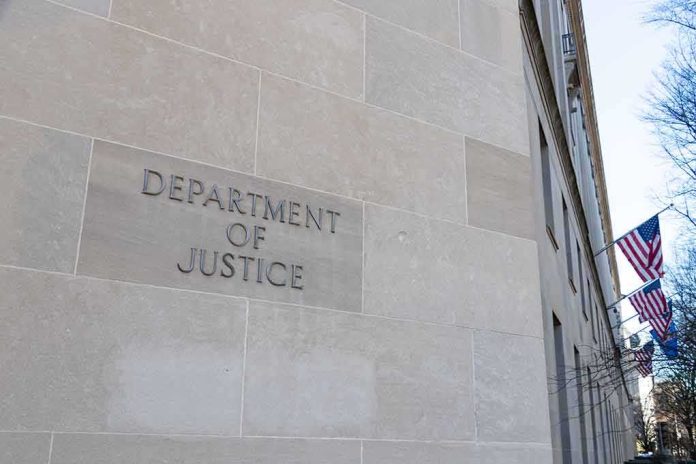
Jeffrey Epstein’s longevity as a predator was not a mystery solved by a single revelation; it was the cumulative result of institutional decisions that blunted accountability, sidelined victims, and collapsed basic custodial safeguards—failures documented by the Justice Department’s own oversight arms and now synthesized by a House review.
At a Glance
- Federal prosecutors ended a broad sex-crimes probe in 2007 with a non-prosecution agreement while shielding victims from meaningful input—judged “poor” by DOJ’s ethics office even if not labeled misconduct.
- Victims were not treated with the forthrightness and sensitivity DOJ standards require, undercutting trust and due process in a case involving minors.
- The House review characterizes “decades-long failures” and urges renewed witness work and survivor access to personal files—practical steps grounded in existing records.
- Custody breakdowns at MCC New York in 2019 showed systemic performance and management failures, reinforcing the pattern of institutional derailments across time.
What the record actually establishes
The strongest, least-contested spine of the Epstein story is institutional. The Justice Department’s Office of Professional Responsibility (OPR) criticized the 2007–2008 federal resolution as an exercise in “poor judgment,” faulting the U.S. Attorney’s Office for resolving an expansive federal investigation through a non-prosecution agreement that foreclosed federal charges in exchange for a state plea—without the level of victim communication and dignity DOJ expects in cases involving minors. While OPR stopped short of finding professional misconduct or corruption, its determinations on judgment and victim treatment are unequivocal and carry the weight of DOJ’s internal watchdog.
The House Oversight Republicans’ report, issued in 2026, builds on that official record. It frames Epstein’s persistence as a product of repeated institutional decisions—by prosecutors, investigators, and custodial authorities—that cumulatively enabled years of abuse, and it calls for renewed interviews or reinterviews of key witnesses and structured access for survivors to their files. These are not symbolic recommendations; they are evidence-driven remedies designed to repair omissions that can be remedied even years later. Parallel findings from the DOJ Inspector General’s 2023 report on Epstein’s federal custody in New York—staffing shortfalls, policy disregard, camera deficiencies, and suicide-risk management failures—complete the picture: the same system that failed to deliver an accountable resolution in 2008 also failed to manage a high-risk detainee in 2019.
How the 2007 agreement short-circuited accountability
By late 2007, federal prosecutors had developed a serious, multi-victim case. Instead of indicting, they executed a non-prosecution agreement resolving federal exposure if Epstein pled to reduced state charges. OPR’s review faults that choice as “poor judgment” and criticizes the failure to treat victims with forthrightness and sensitivity—particularly the failure to ensure victims were meaningfully informed before the resolution was secured. The review also explains its boundary: it found no clear, unambiguous legal duty at the time to consult victims before finalizing the agreement, which is why it did not classify the conduct as professional misconduct, even as it condemned the decision-making. That matters; it distinguishes legal culpability for prosecutors from the policy and ethical critique that the agreement betrayed sound federal practice.
This distinction has been misused to argue that because misconduct was not found, the decision was defensible. That is not what OPR concluded. The record supports a narrower, firmer point: DOJ’s own internal oversight deemed the judgment flawed and the treatment of victims substandard, irrespective of the absence of a disciplinary finding.
Victims, transparency, and the limits of secrecy
The OPR statement is plain: victims were not treated with the forthrightness and sensitivity DOJ expects. That is more than a procedural footnote—it is the heart of how exploitation persists. When minors are denied transparent processes, they are denied a chance to be heard in real time, to correct the record, and to prompt investigators to pursue leads that only they can surface. The House report’s call to establish a survivor-access process and to reengage witnesses is a direct response to that deficit and is proportionate to the evidentiary gaps the federal resolution created.
Transparency has another limit: the Privacy Act and survivor protection. DOJ has said those constraints prevented release of OPR’s full report to the public, even while permitting congressional access; that is a defensible privacy rationale but it inevitably reduces public visibility into the full evidentiary basis of OPR’s judgments. The remedy is targeted oversight, not indiscriminate disclosure—precisely what the House recommendations aim to operationalize.
What custody failures tell us about the system
Institutional failure did not end with a plea deal. The Inspector General’s 2023 review of Epstein’s confinement at MCC New York found significant performance and management failures, including disregard of policy, staffing deficiencies, and camera-system problems—an indictment of operational controls in a high-stakes detention setting. Although distinct from prosecutorial choices in 2007, these findings reinforce a through-line: rules and risk controls that exist on paper were not executed when it counted. In safeguarding, function—not form—governs outcomes.
It is tempting to dismiss custody breakdowns as isolated human error. The OIG record makes that untenable. Multiple layers—supervision, compliance checks, and technology—degraded simultaneously; in risk management terms, defenses-in-depth failed in series. That does not prove a conspiracy; it does prove an unsound system.
🚨 BREAKING: The U.S. House Oversight Committee has released a major investigative report exposing decades of failures by federal authorities in the Jeffrey Epstein and Ghislaine Maxwell cases.
The 15-month investigation details how Epstein cultivated relationships with powerful…
— Sophie B (@sophie_bpage) November 11, 2026
Separating association, denial, and evidence
The public conversation around Epstein often fixates on names in logs and photos. That is not how accountability is built. The House report does not purport to convert social proximity into criminal liability. It concentrates on institutional choices that can be documented and corrected. Indeed, several individuals publicly deny knowledge or facilitation; standing alone, those denials neither rebut the institutional record nor prove culpability. The strongest findings in the file remain those anchored in official reviews and policy failures, not guilt-by-association lists.
Counter-arguments that prosecutors committed no professional misconduct, or that decisions were not driven by corruption, do not disturb the core: DOJ’s own oversight says judgment was poor and victims were ill-served; the Inspector General documents severe custodial failures. Those conclusions are specific, sourced, and durable.
What a credible path forward looks like
Credible reform begins where the evidence points. First, conduct targeted reinterviews of witnesses and associates who interacted with victims, using document-controlled timelines to test what was known and when; the House report’s recommendations provide a map for that work. Second, institutionalize survivor access to their personal files with clear redaction policies that protect privacy without erasing substance—an operational fix that directly addresses past opacity. Third, translate the OIG’s custody findings into enforceable staffing, supervision, and technology benchmarks for high-risk detainees; audits should track compliance to closure, not mere policy issuance.
Finally, remember what this case is and is not. It is a record of organizations that chose expedience over rigor, process over people, and reputation management over safeguarding. The corrective is not theatrical disclosure or partisan point-scoring; it is disciplined oversight that compels better decisions, documents them, and centers the victims who were previously sidelined.
Sources:
cbsnews.com, justice.gov, politico.com, bloomberg.com, epstein-index.org, oig.justice.gov