
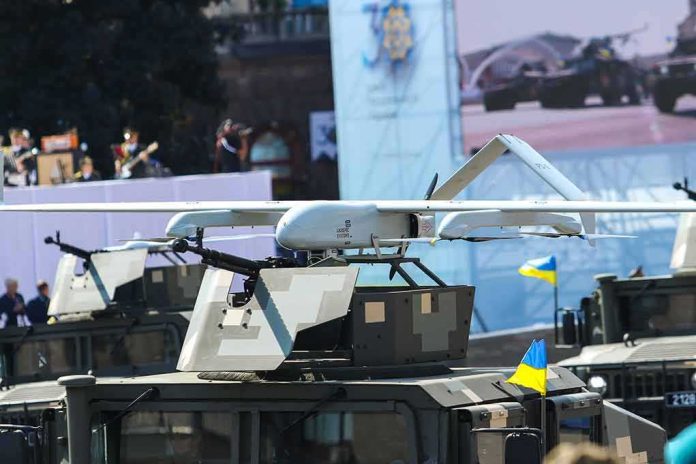
A wounded Ukrainian soldier spent two days trapped in a minefield before help finally arrived, not on wheels or on foot, but in the air, carried home by a drone with no pilot inside.
Quick Take
- Ukraine’s 92nd Separate Assault Brigade says a heavy hexacopter drone flew a wounded infantryman off the battlefield, calling it the first-ever aerial combat evacuation.
- Landmines and swarms of Russian attack drones made a ground rescue impossible, so commanders sent an unmanned aircraft instead.
- A separate soldier, known by the call sign Magura, was pulled from the “grey zone” after 491 days trapped near enemy lines and lost both feet.
- Another rescued soldier, Kostiantyn Vlasenko, weighed about 176 pounds and was carried roughly 11 miles to safety strapped to the drone.
A Rescue the Ground Could Not Reach
Footage shared by Ukraine’s 92nd Assault Brigade shows a wounded infantryman strapped into a large hexacopter built by the Ukrainian company Gurzuf Defence. The aircraft lifts off the ground, climbs over the battlefield, and lowers him at a location far from enemy fire. The brigade called it the first battlefield air evacuation by drone in history.
A second case involved a soldier from Ukraine’s 30th Separate Mechanised Brigade, known by the alias Magura. He had been stuck in the no-man’s-land between the two armies for 491 days before a Heavy Shot drone finally lifted him out. He lost both feet to his injuries during that stretch.
Two Days Trapped, Then an Aircraft With No Pilot
In the case that drew the most attention, the wounded soldier waited two days before rescue came. Mines littered the ground around him, and Russian drones patrolled the sky, making a walk-out or a vehicle run too dangerous to attempt. Ukrainian forces said the drone was the only option left. One Ukrainian official described these aircraft as a “lifeline of last resort,” used only when every other path to safety has closed.
A third rescued soldier, Kostiantyn Vlasenko, weighed about 176 pounds. He was hoisted by the heavy-lift drone and carried roughly 11 miles back to Ukrainian lines while smaller drones flew alongside to guard the route from attack. Each case followed the same pattern: a soldier too hurt and too exposed to move on his own, and a machine built to go where people could not.
Why Battlefield Medicine Is Moving to the Sky
These rescues did not happen in a vacuum. Across the front, constant drone surveillance has turned medical evacuation routes into shooting galleries. One medical analysis found that more than 60 percent of wounded soldiers in a 2025 sample reached help outside the safe window for tourniquet care, compared with just 15 percent in 2016, as evacuation stages get pushed farther from the fighting.
NATO’s long-standing evacuation goal, often called the “10-1-2” rule, calls for first aid within 10 minutes, advanced care within an hour, and surgery within two hours. Military researchers now say that timeline has become nearly impossible to meet on a battlefield saturated with cameras and strike drones.
Ukraine has achieved many historic firsts in this war. Here is another one: the first-ever aerial medical evacuation of a wounded soldier using a heavy-lift drone.
On the Kupiansk front, Ukraine’s Defence Forces rescued Kostiantyn Vlasenko of the 30th Mechanized Brigade, who had… pic.twitter.com/lehLzHgfHM
— Andrii Sybiha 🇺🇦 (@andrii_sybiha) October 24, 2026
Researchers studying unmanned systems have noted that drone-based evacuation is still a young idea, with few documented cases before this year. That makes these rescues more than a one-time stunt. They point to a shift already underway, where getting a wounded soldier out alive may depend less on trucks and helicopters and more on machines built to fly through the kind of danger no human crew could survive.
Sources:
pravda.com.ua, aerotime.aero, yahoo.com, apnews.com, tomshardware.com, academic.oup.com, link.springer.com, wim.mil.pl