Three commercial ships were hit by deadly projectiles near the Strait of Hormuz, and the rush to blame Iran is raising as many questions about global power and truth as it answers about the attack itself.
Story Snapshot
- Three commercial vessels were struck near the Strait of Hormuz, including a Qatari gas tanker that caught fire.
- U.S. and Gulf governments publicly blame Iran and have already launched major retaliatory strikes.
- Iran avoids a clear admission, hinting at warnings but leaving key facts and legal claims in dispute.
- The incident deepens a long-running pattern of attacks on shipping in Hormuz and fuels distrust of global elites on all sides.
What We Know About The Attack On The Qatari Tanker
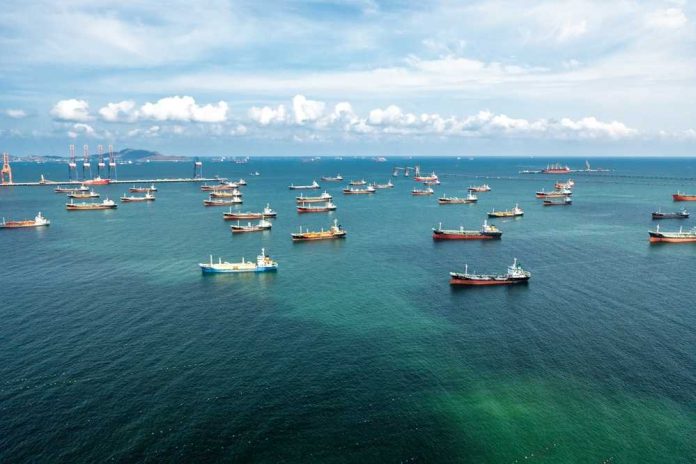
Late Monday, a liquefied natural gas tanker sailing south near Limah, off the coast of Oman, was hit on its left side by a projectile that triggered a fire in the engine room, according to the United Kingdom Maritime Trade Operations, a British agency that tracks threats to ships. The ship, widely identified by officials and media as the Qatari tanker Al Rekayyat, sent distress signals but its crew survived. This attack occurred in or near Oman’s territorial waters close to the narrow Strait of Hormuz, a chokepoint for global oil and gas flows.
British and regional reports described the weapon only as an “unidentified projectile,” which leaves open whether it was a missile, drone, or something else. Iranian television later carried claims that the tanker was attacked after ignoring warnings, but those reports relied on unnamed sources and did not include a formal statement from Iran’s government or the Islamic Revolutionary Guard Corps admitting responsibility. That gap between hard physical damage and soft, anonymous attribution is central to the dispute over what really happened and why.
U.S. And Gulf Allies Blame Iran And Hit Back
A United States official told reporters that Iran fired at least two missiles at commercial ships in or near Oman’s waters, severely damaging two vessels and striking a third. U.S. Central Command later said in a public release that Iranian forces had recently attacked three specific tankers: Marshall Islands–flagged Al Rekayyat, Saudi Arabia–flagged Wedyan, and Liberian‑flagged Cyprus Prosperity. Qatar’s Foreign Ministry called the attack on Al Rekayyat “unacceptable” and a “serious and clear violation of international law,” and said Iran is fully legally responsible.
Saudi Arabia’s Foreign Ministry said its crude oil tanker Wedyan was also attacked while crossing the Strait of Hormuz and declared that Iran “bears full responsibility” for strikes on both Saudi and Qatari ships. In response, the U.S. military launched a large wave of strikes against Iranian air defenses, command sites, coastal radars, anti‑ship missiles, and dozens of Islamic Revolutionary Guard Corps boats, saying the goal was to impose “heavy costs” for attacking commercial shipping and to protect freedom of navigation. These strikes came even as Washington and Tehran were supposed to be observing a ceasefire meant to wind down the wider war.
Iran’s Ambiguous Position And The Evidence Gap
Iran’s leaders publicly condemned the new U.S. strikes and argued that Washington, not Tehran, is breaking the ceasefire deal and threatening regional stability. Iranian television and semi‑official outlets suggested that the Qatari tanker had ignored warnings before being hit, painting the action as enforcement of Iran’s claimed right to control shipping in the strait, but they stopped short of a clear, official admission that Iranian forces carried out the attack. Neither Iran’s Foreign Ministry nor the Islamic Revolutionary Guard Corps issued detailed evidence to counter U.S. claims about missiles, launch sites, or the exact number of damaged ships.
This leaves a key problem: major governments and militaries have already acted as if Iran’s guilt is settled, yet the public has not seen forensic proof such as missile debris analysis, verified radar tracks, or sworn crew testimony linking the projectiles to specific Iranian units. For many Americans across the political spectrum, that looks familiar. They remember past wars and crises where elites pushed hard narratives while ordinary people were told to “trust the intelligence” without seeing the underlying facts. That history makes it harder to simply accept either Washington’s or Tehran’s version at face value today.
A Wider Pattern In Hormuz And Why It Feeds Public Distrust
These latest attacks are not a one‑off event. Since late winter, Iran’s Islamic Revolutionary Guard Corps has escalated threats and strikes on commercial shipping in and near the Strait of Hormuz, using missiles, drones, and speed boats to enforce what it calls a closed zone for certain traffic. U.S. defense officials and independent analysts say at least a dozen ships have been hit or harassed in the crisis period, showing a clear pattern of risk for energy and trade routes that many everyday Americans rely on indirectly through fuel prices and the broader economy.
The Strait of Hormuz was quiet the way a rattlesnake is quiet. Then Iran moved.
By Francis Gauthier
Three commercial vessels tied to Qatar, Saudi Arabia, and the United Arab Emirates were targeted near the narrow waterway that carries a major share of the world’s oil traffic.… pic.twitter.com/NktjfPR88g— Faith Gonzales (@faith3155) July 9, 2026
For conservatives worried about energy costs and national strength, the idea that foreign forces can hit tankers and shake oil markets while Washington scrambles from one strike package to the next feels like more proof that the system is not really working for them. For liberals worried about endless conflict, growing inequality, and the power of unaccountable elites, the mix of secret intelligence, fast military action, and limited public evidence looks like yet another reminder that big decisions are being made far above citizens’ heads. Both sides can see how a distant fight over ships in Hormuz links back to a common fear: a global order run by people who ask for trust, demand sacrifice, and too often leave ordinary families to carry the cost.
Sources:
insiderpaper.com, cnn.com, npr.org, upr.org, pbs.org, apnews.com, crisisgroup.org