
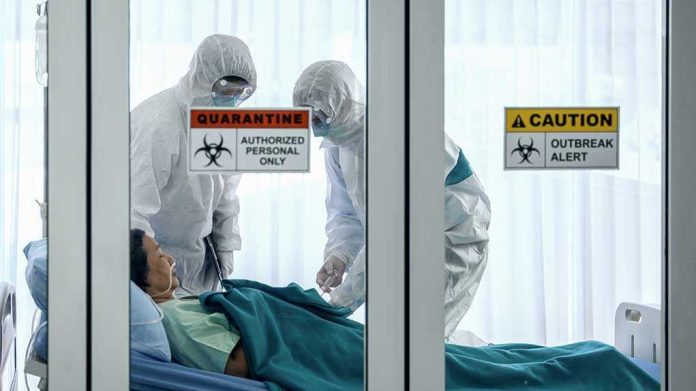
A federal health showdown over one woman in a Nebraska quarantine unit is exposing just how much power Washington still claims over your basic freedom to go home.
Story Snapshot
- Health Secretary Robert F. Kennedy Jr. overruled federal medical experts to keep a Florida woman quarantined in Nebraska.[1][3]
- A Centers for Disease Control and Prevention (CDC) reviewer said she could safely finish her quarantine at home with monitoring.[3][11]
- Critics say the order relies on vague “public health” claims while dodging due‑process protections built after past abuses.[1][11][13]
- The fight highlights the dangerous reach of federal quarantine power and why conservatives must watch it closely.[12][14][18]
Why One Cruise Passenger Is Still Stuck in Nebraska
United States Health Secretary Robert F. Kennedy Jr. has ordered Angela Perryman, a 47‑year‑old cruise passenger from Florida, to remain in a federal quarantine facility in Nebraska after possible exposure to Andes hantavirus on a South Atlantic cruise.[1][3] A Centers for Disease Control and Prevention medical review found she did not need to stay confined so far from home and could safely quarantine in Florida under daily monitoring for symptoms.[3][11] Despite that expert finding, Kennedy signed a new order saying continued quarantine was needed “to protect public health,” without giving a specific medical reason tied to Perryman herself.[1][3]
Perryman was among Americans evacuated in May after a rare hantavirus outbreak on the cruise ship that killed three people.[1][3] Reports say about seventeen or eighteen American passengers were sent to a special federal unit in Omaha for evaluation and observation, with some later allowed to finish their quarantine at home once their states agreed to strict checks.[1][5] Perryman says she understood she could do the same in Florida once a May 31 date passed, but when Florida health officials declined to take on the federal monitoring plan, Kennedy’s department told her she had to stay put in Nebraska instead.[1][3]
What the Experts Recommended — and Why Kennedy Said No
Under federal rules updated in 2017, anyone held under a federal quarantine order has the right to a medical review by an independent Centers for Disease Control and Prevention physician who did not sign the original order.[11][14] In Perryman’s case, that role fell to Dr. Michael Bell, a senior quarantine medical officer at the Centers for Disease Control and Prevention.[3] After a hearing with testimony and written submissions, Bell concluded Perryman could safely finish the forty‑two‑day observation period at home in Florida with daily remote symptom checks and a clear hospital plan if she became sick, calling this the “less restrictive” option that still protected public health.[2][3]
News outlets that reviewed Bell’s written report say he found continued confinement in Omaha was not medically necessary, especially because other passengers with similar exposure had already been allowed to leave under home‑based monitoring plans.[2][4] Legal and medical experts at the review meeting reportedly agreed that Florida’s proposal for check‑ins and local follow‑up was reasonable and met the government’s safety goals.[1][4] Yet Kennedy signed a one‑page order rejecting Bell’s recommendation, stating only that Perryman “remains a risk” and that keeping her in Nebraska was needed to protect public health, without giving a case‑specific explanation.[2][3]
How Federal Quarantine Power Grew — and Why It Worries Civil Liberties Advocates
Federal quarantine power comes from section 361 of the Public Health Service Act, a World War II‑era law that lets Washington stop the spread of named diseases across borders and between states.[12][14] Over time, Congress and federal agencies shifted more authority from local health boards to Washington, creating national quarantine rules and port health stations that now sit at major airports and seaports.[12][15] In 2017, the Department of Health and Human Services and the Centers for Disease Control and Prevention issued a major rule that spelled out how federal officials can detain, examine, quarantine, and conditionally release travelers believed to be exposed to dangerous diseases.[11][14]
Legal scholars have warned that those updated rules lean heavily on confining people who may not be sick yet, while offering limited real due‑process protections.[13] One law review article argues that modern federal quarantine often fails to stop outbreaks but still causes serious civil liberties harms when the government uses broad powers on thin or uncertain evidence.[13][18] The rules do require a written medical review and allow people like Perryman to contest their confinement, but they also let senior officials, such as the Centers for Disease Control and Prevention director or the Health and Human Services secretary, reject those medical recommendations and continue holding someone if they say the legal criteria are still met.[11][14]
Why This Case Should Matter to Conservatives
For many conservatives, the COVID‑19 years showed how fast “public health” can become a blank check for shutdowns, travel bans, and even tracking people’s movements, often with little transparency or accountability. The Perryman case shows that those tools did not disappear; they are now baked into federal rules and can be used by any administration, even when expert reviewers inside the same agency say there is a safer, less restrictive option.[11][13] The fact that the order keeping her detained gives almost no specific reasoning makes it harder for citizens, states, or courts to judge if the power is being used fairly.[1][2]
"I WANT TO BE ABLE TO WALK OUTSIDE": RFK Jr. has refused to release a cruise ship passenger exposed to hantavirus from a quarantine facility, despite a federal medical review finding that confining her far from her Florida home is unnecessary. https://t.co/ALGzkGZj5g pic.twitter.com/ncb7wClX2a
— WFLA NEWS (@WFLA) June 16, 2026
Supporters of strong quarantine powers argue that Andes hantavirus has a high fatality rate and that the government must err on the side of caution to prevent person‑to‑person spread.[5][6] They point out that federal law allows temporary limits on individual freedom during real health threats. But long experience shows that once Washington claims an emergency power, it rarely gives it back, and vague orders that overrule clear medical advice can set precedents for broader crackdowns later.[12][13][18] For readers who value limited government, state authority, and basic due process, Perryman’s fight to simply go home is a reminder to watch federal health power as closely as any tax hike or gun regulation.
Sources:
[1] Web – RFK Jr. overrules experts to keep hantavirus cruise ship passenger in …
[2] Web – RFK Jr. Orders American Exposed to Hantavirus to Stay … – WSJ
[3] Web – Kennedy Orders Woman to Stay in Hantavirus Quarantine, Despite …
[4] Web – RFK Jr. rejects CDC review backing home quarantine for hantavirus …
[5] X – Health Secretary Robert F. Kennedy Jr. ordered an American …
[6] Web – RFK Jr. says hantavirus situation is ‘under control’ – The Hill
[11] Web – Hantavirus cruise passenger says she’s being forced to quarantine …
[12] Web – HHS secretary rejects CDC analysis on quarantine – Facebook
[13] Web – RFK Jr. orders hantavirus cruise passenger to remain … – Healthbeat
[14] Web – RFK Jr. overrules experts to keep hantavirus cruise ship passenger …
[15] Web – [PDF] Federal Register/Vol. 82, No. 12/Thursday, January 19, …
[18] Web – The Cdc’s Communicable Disease Regulations – Books and Journals