
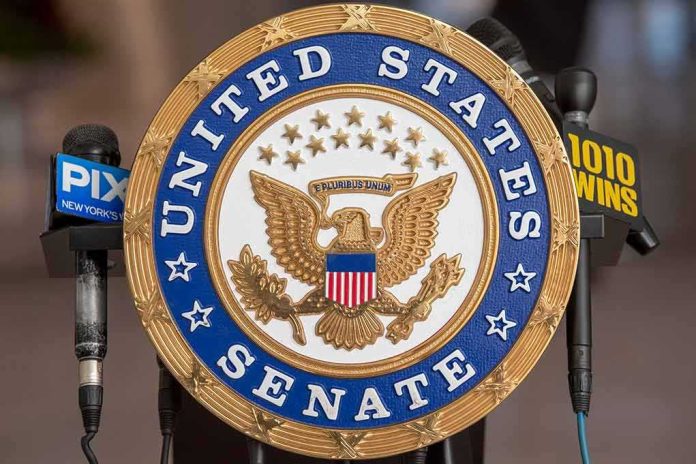
A Democrat-led push to tie President Trump’s hands on Iran just failed again in the Senate, keeping critical commander-in-chief authority in the White House instead of in the hands of Washington’s permanent political class.
Story Snapshot
- Senate rejected yet another resolution to restrict Trump’s ability to use force against Iran.
- Measure would have forced any continued or new hostilities to get explicit approval from Congress first.
- Democrats framed it as a War Powers fight, but the vote fell mostly along party lines.
- Trump retains flexibility to respond quickly to Iranian threats and protect U.S. troops and allies.
Senate Blocks Latest Attempt to Tie Trump’s Hands on Iran
Senators in Washington once again voted down a resolution that would have limited President Donald Trump’s authority to carry out military action against Iran without a fresh green light from Congress.[5] The measure was part of a long-running campaign by Democrats, and a small number of Republicans, to force Trump to seek explicit authorization before continuing or expanding the conflict. Supporters claimed they were defending the Constitution, but the vote mainly split along party lines in favor of the president’s current powers.[5]
This latest defeat was not the first time lawmakers tried to box in Trump on Iran, and it likely will not be the last.[5] Earlier efforts also failed in the Senate, including a 53 to 47 vote in 2025 against a similar resolution that would have required congressional sign-off for any new strikes after Trump hit several Iranian nuclear facilities.[4] Each time, Democrats framed the effort as a check on “endless war,” while many Republicans argued the president must be able to act fast when American lives are on the line.[4]
How the War Powers Fight Became a Political Weapon
Backers of the Iran resolution leaned on the War Powers Resolution of 1973, a law from the Vietnam era that says the president must notify Congress within 48 hours of sending forces into hostilities and end those actions within 60 days unless lawmakers approve.[16] Advocacy groups and some scholars argue this law means Congress must clearly authorize any extended conflict with Iran, not just sign off on funding after the fact.[15] They say silence from Congress is not consent and insist on specific votes to continue military action.[15]
For years, though, both parties in Congress have failed to follow through when it really counts.[14] Analysts point out that even when lawmakers pass measures to reclaim war powers, they almost never muster the two-thirds majorities needed to override a presidential veto.[14] That pattern turns many of these votes into political theater instead of real limits on the executive branch. Presidents of both parties have also stretched their claimed authority, often citing the need to protect U.S. forces or allies from imminent threats.[17] Trump’s team has made similar arguments in defending his Iran decisions.[17]
What the Defeat Means for Conservatives and National Security
For conservative readers, the Senate’s rejection means Trump keeps the agility to respond quickly if Iran targets American troops, bases, or partners.[5] The failed resolution would have forced the White House to wait on Congress for future operations unless they fit a narrow view of self-defense. Given how slowly Congress moves, especially in an election year, many on the right see that as a direct risk to U.S. lives and to deterrence against a hostile regime in Tehran that has shown it will test American resolve.[17]
In Washington, a major housing bill now includes a prohibition on the Federal Reserve issuing a central bank digital currency until the end of 2030. This is one of the more concrete legislative limits placed on CBDC development in recent years.
Separately, the Senate rejected a…— Mituye (@MituyeHQ) June 17, 2026
At the same time, the fight highlights a real tension inside our system that conservatives care about: keeping both the president and Congress within the limits of the Constitution.[16] The Constitution gives Congress the power to declare war, but it also makes the president commander in chief of the armed forces. Conservative legal voices argue the proper balance is this: Congress decides if we are at war, but once conflict is underway, the president directs the fight, including fast action against new threats.[15] The Iran votes show how far Washington has drifted from that clear, shared understanding, turning a serious issue of war and peace into another beltway power struggle.[14]
Sources:
[4] YouTube – House votes to rein in Trump’s military action against Iran
[5] Web – Roll Call Vote 119 th Congress – 2 nd Session – Senate.gov
[14] Web – My statement on the Iran War Powers Resolution. – Instagram
[15] Web – Congress’s Role in Military Conflict: The Growing Gap Between …
[16] Web – Reclaiming Congressional War Powers – The Chamberlain Network
[17] Web – War Powers Resolution of 1973 | Richard Nixon Museum and Library