
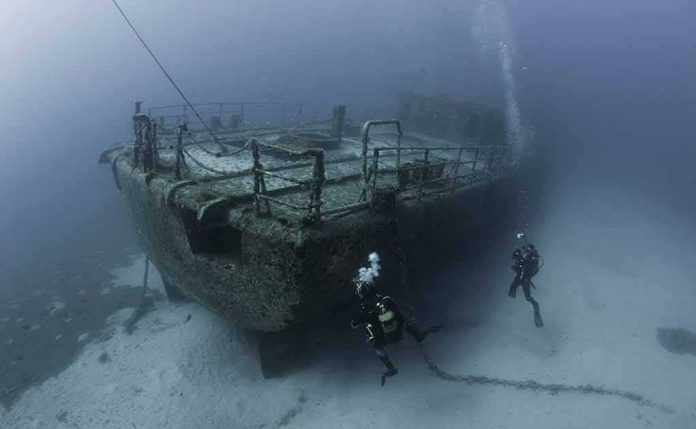
Komsomolets is the archetype of a hard radiation problem: a confirmed leak from a deep-ocean nuclear wreck that matters scientifically and for policy, yet has not translated into measurable harm in fisheries or people. Both truths stand, and understanding the mechanism that allows them to coexist is the key to judging risk and next steps.
The Short Version
- Direct sampling in 2019 found cesium-137 in a wreck ventilation pipe at concentrations orders of magnitude above ambient seawater, confirming an active source on the submarine decades after sinking.
- The extreme readings were highly localized; rapid dilution at 1,700 meters depth has kept broader Norwegian Sea levels low and seafood risk negligible, according to Norwegian authorities.
- Evidence supports reactor-derived leakage; there is no confirmed environmental release from the two plutonium-armed torpedoes.
- The policy question is long-term stewardship: continued monitoring is warranted, but engineering intervention remains contested because disturbance could worsen releases.
What the science has established: a continuing, localized reactor leak
In July 2019, a Norwegian research cruise used a remotely operated vehicle to sample seawater “directly from the ventilation pipe where releases have previously been documented.” Laboratory measurements detected cesium-137 as high as 857 Bq/L within the pipe—explicitly interpreted by the expedition as evidence that “releases from the reactor are still occurring, 30 years after ‘Komsomolets’ sank.” For perspective, typical Norwegian Sea water carries roughly thousandths of a becquerel per liter of cesium-137; that is why headlines touted ratios in the hundred-thousand to eight-hundred-thousand range. Ratios aside, the point is simpler: the wreck is still bleeding reactor fission products into the pipe-connected interior and out into the surrounding water column.
This was not a one-off anomaly. Norwegian scientists noted that Russian teams had observed releases from the same ventilation structure in the 1990s and again in 2007, a pattern consistent with intermittent pulses as internal compartments exchange with ambient seawater under changing current and pressure conditions. That pathway—internal compartments communicating with the sea via ducting—explains why the hottest samples occur in or immediately adjacent to a pipe rather than broadly across the site.
Why the high numbers did not translate into a fishery crisis
Two features of the setting prevent localized spikes from becoming a regional hazard. First, depth: at roughly 1,700 meters, any release is diluted in an enormous, cold, and vigorously mixing volume of water before it can rise or spread along biologically dense surface layers. Second, the leak is constrained by the wreck’s geometry; water with elevated activity exits near the structure and disperses quickly into background. Norway’s Institute of Marine Research and the Radiation and Nuclear Safety Authority were unequivocal about this distinction in 2019: the results confirm leaking, but “what we have found on this expedition will not have any impact for Norwegian fish and seafood” because the releases are rapidly diluted.
That messaging can sound contradictory until one separates three different questions that tend to be conflated in public debate: is contamination present, is it spreading beyond the near field, and is anyone receiving a meaningful dose or is the ecosystem being measurably altered? The answer set here is yes, uncertain/minimal, and no, respectively, given current measurements. The 2019 cruise emphasized cesium-137 because it is a clear reactor fingerprint in seawater; it also proposed further analyses for strontium-90, plutonium isotopes, and uranium. Those laboratory lines matter for tracing sources and long-term risk, but the published finding that drives today’s risk picture is cesium in the ventilation pathway; strontium-90 and plutonium were not reported as confirmed environmental releases from the site.
The warheads versus the reactor: different inventories, different risks
Komsomolets carried two nuclear-tipped torpedoes in the bow and a single pressurized-water reactor amidships. Reactor fuel releases fission products such as cesium-137 when compromised; warhead leakage would be traced through plutonium isotopes with distinct ratios. Decades of joint and parallel investigations have repeatedly pointed to reactor-derived cesium as the near-field signal, while open reporting has not confirmed weapons-grade plutonium in surrounding seawater or sediments near the wreck. That does not mean the warheads pose no future risk—only that present measurements do not show their signature in the marine environment.
Even Russian designer Igor Spassky, while arguing against alarmism in the 1990s, acknowledged corrosion as the long clock to watch. Cold, deep water slows deterioration, buying time; it does not grant immunity from physics. His stance—serious but not catastrophic—has remained broadly aligned with the Norwegian position: monitor, do not panic, and avoid interventions that could trigger larger releases by disturbing a fragile equilibrium.
Mechanism and measurement: how a wreck “breathes” radionuclides
Inside a sunken submarine, compartmentalized spaces, residual gases, and the geometry of trunks and ducts create a dynamic exchange with the ocean. As currents and pressure differentials shift, seawater intrudes, reacts with metals and any remaining fuel matrices, and then vents through available pathways. A ventilation pipe is an obvious conduit; sampling it captures the highest activity before rapid dilution scrubs the plume. That is precisely what the 2019 team did—targeting the structure most likely to carry reactor-sourced water outward. The result is a measurement optimized for detection at the source, not an estimate of average conditions in the Norwegian Sea. Any responsible reading of the data must hold those two realities in view simultaneously.
From a monitoring standpoint, the unsolved technical questions are scale, intermittency, and fate: how often do pulses occur, at what volumes and activities, and how quickly do radionuclides migrate into sediments or biota rather than remaining in the water column? Those answers require repeated near-field sampling, flow characterization at the pipe, and mass-balance modeling to turn concentrations into release rates—work that sits downstream of the 2019 confirmation.
Policy and engineering: why “do no harm” competes with “fix the leak”
Proposals over the years have spanned sealing, encapsulation, and, at the other extreme, full recovery. Each comes with hard engineering constraints: 1,700 meters is a punishing work environment; the wreck is a war grave under Russian jurisdiction; and any invasive action risks destabilizing corroded structures that currently meter releases through small pathways. Norwegian authorities have therefore prioritized surveillance and transparency: keep the instruments on, publish methods and data, and refine risk communication so the public understands that “no threat to seafood” does not mean “no leak,” and that a dramatic ratio near a pipe is not the same as a region-wide contamination event.
The sensible middle path is clear. First, maintain and deepen the time series at the source—same pipe, comparable protocols—to capture variability and trend. Second, extend laboratory work to high-sensitivity assays of strontium-90 and plutonium isotopes in near-field water, sediments, and biota to close source-term uncertainties. Third, publish raw data, coordinates, and detection limits to enable independent replication; confidence grows with interlaboratory agreement, not press statements. These steps match what the 2019 cruise outlined and what long-lived marine monitoring programs, including IAEA-supported networks, are designed to do.
How to read the next headline about Komsomolets
When the next expedition reports back, expect two stories at once. The scientific story is about mechanisms and magnitudes—how radionuclides move from a confined, corroding reactor system through a defined pathway into a vast, diluting ocean. The public story is about scale and consequence—what matters for seafood safety, for regional ecology, and for trust in institutions managing a dangerous relic of the Cold War. The evidence to date supports continued vigilance without alarm: a leaking source confirmed at the wreck; dilution preventing wider harm; unresolved but testable questions about other radionuclides and future corrosion. Hold those pieces together, and the picture becomes coherent—and actionable.
Sources:
19fortyfive.com, dsa.no, themoscowtimes.com