
A capital murder charge filed in Mobile County, Alabama, alleges that a 47-year-old man used a chainsaw to decapitate his grandmother and his aunt inside the home they shared on Carolina Court, and the case now moving through the Mobile County court system illustrates, in unusually stark terms, how the earliest days of a capital prosecution unfold long before any jury hears evidence.
Key Points
- Thomas Steele faces two counts of capital murder after Mobile police found Christy DeLoach and Dora Boone dead in a West Mobile home on October 12, 2026
- A criminal complaint alleges Steele decapitated both women with a chainsaw “by one act or pursuant to one scheme or course of conduct”
- A judge denied bond at Steele’s October 13 initial appearance and ordered a competency evaluation after Steele made a disturbing remark in court
- A 911 call placed before the killings reportedly referenced Steele being off medication, adding a mental-health dimension that will shape how the case proceeds
- The case has not gone to trial, and the publicly available record does not yet include forensic test results, a detailed timeline, or trial testimony
What The Charging Documents Allege
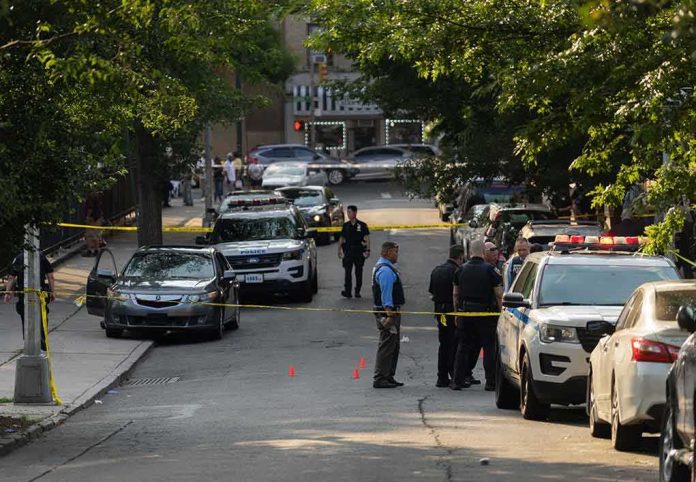
Mobile police responded to the 2400 block of Carolina Court at approximately 1:36 p.m. on October 12, 2026, and found two women dead inside the residence; officers detained Thomas Steele at the scene. A criminal complaint filed the following day in Mobile County alleges that Steele used a chainsaw to kill both Christy DeLoach and Dora Boone, his aunt and grandmother, describing the deaths as occurring “by one act or pursuant to one scheme or course of conduct” — language that ties the two killings together under Alabama’s capital murder statute for multiple deaths in a single episode. A Mobile Police Department release separately stated investigators determined Steele used a “bladed instrument to intentionally cause the deaths of two family members”.
At Steele’s initial appearance on October 13, a judge denied bond and ordered a competency evaluation through the Alabama Department of Mental Health, a process Mobile County District Attorney Keith Blackwood said typically takes up to 90 days. When the court appointed a public defender and asked Steele whether he could hire his own attorney, Steele answered “no,” then responded with a remark directed at the appointed lawyer that led the court to remove him from the proceeding without incident. Blackwood told reporters afterward that he is “not a psychiatrist, but nevertheless it appears that there are some issues,” underscoring that the competency question, not the underlying facts of the killings, is what will determine the case’s next procedural step.
The 911 Call And The Hours Before The Killings
Separate reporting describes a 911 call placed before the homicides in which a woman told dispatchers she had already tried reaching Steele through the 988 mental-health crisis line and indicated he was off his medication. A source cited in that same reporting said Steele was waiting outside the home when officers arrived. These details matter less as evidence of guilt — which remains the charging theory’s claim to prove — and more as context for the competency question now before the court: Alabama law requires that a defendant understand the proceedings against him and be able to assist in his own defense before a capital trial can proceed, and a documented history of psychiatric crisis in the days or hours before an alleged offense is precisely the kind of fact that competency evaluators and, later, sanity-defense litigation typically examine.
How Capital Cases Move From Complaint To Conviction
It is worth understanding the architecture of a capital prosecution, because the gap between a filed complaint and a proven case is wide by design. A complaint or indictment states what prosecutors believe they can prove; it is not itself evidence, and under Alabama law — as in every state — a defendant is presumed innocent until the state meets its burden at trial. Between arraignment and trial, prosecutors are generally required to turn over forensic reports, the chain of custody for physical evidence, witness statements, and the probable-cause affidavit underlying the arrest, material that in a case of this gravity would include whatever testing connects a suspect to a weapon, a scene, and a cause of death as determined by a medical examiner. None of that evidentiary record is yet public in this case, which is ordinary at this stage rather than unusual; capital cases routinely take a year or more to reach trial, and competency findings alone can add months.
Why Cases Like This Deserve Patience, Not Just Attention
Mugshots that show an unexpected expression, courtroom outbursts, and a weapon as visceral as a chainsaw are the kind of details that travel fastest and furthest in crime reporting, and they did so here across multiple outlets within a day of the arrest. That velocity is not evidence of anything beyond the facts those outlets independently gathered from police and court sources, but it is worth remembering that criminal-justice research has repeatedly found that early, emotionally charged narratives in a case can outpace the slower work of forensic verification — a pattern scholars studying wrongful convictions have tied to overreliance on eyewitness accounts, contested forensic methods, and incomplete investigative records in a meaningful share of cases that were later overturned. That history does not cast doubt on any specific fact alleged here; it is a reason the system builds in competency review, discovery, and trial before a charge becomes a conviction, and a reason the public record in capital cases is worth following through to its actual resolution rather than only at its most dramatic opening chapter.
BREAKING UPDATE: One of the Mobile double-homicide victims, found decapitated in a West Mobile home, is a local hair stylist who was a familiar, beloved face at one salon for 15 years. #linkinbio for story pic.twitter.com/t2UzKlWVHo
— WKRG (@WKRG) October 14, 2026
What Comes Next
The immediate procedural question is competency: whether Steele can understand the charges and assist his defense, a finding that will determine whether the case proceeds toward trial, moves to restoration treatment, or follows another track entirely. Blackwood has indicated prosecutors intend to proceed with the capital charges regardless of that evaluation’s complexity. Until a competency finding is entered and discovery materials are produced, the case remains, factually, exactly what the complaint says it is: a serious, specific allegation that has not yet been tested in court.
Sources:
wkrg.com, kcrg.com, fox10tv.com, wbrc.com, wpxi.com