
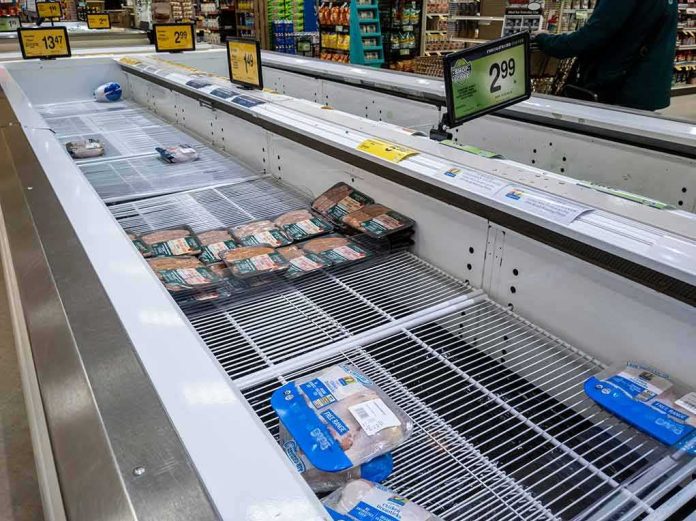
When software reaches into the physical world, small lapses become large losses; France’s supermarket freezer incident shows how a single weak link in connected controls can ripple across a nation’s food supply in hours.
At a Glance
- French authorities opened a criminal probe into a coordinated cyberattack that manipulated supermarket refrigeration controls across multiple chains.
- The prime minister’s office tasked ANSSI, France’s national cybersecurity agency, to investigate and coordinate with European counterparts.
- Early reporting points to targeted Danfoss refrigeration controllers, with affected units running outdated firmware; Danfoss confirmed incidents in France and urged updates and migrations for legacy systems.
- The pattern—remote commands driving fridges into abnormal heat—fits known operational-technology risks where connectivity outpaces security practice.
What happened: a coordinated hit on connected cold chains
French prosecutors opened a formal criminal investigation into a large-scale cyberattack that interfered with the refrigerators and freezers of several major retail chains, driving temperatures abnormally high and forcing food disposal at scale. The Paris prosecutor’s office characterized the event as a cyberattack and assigned the case to the anti-cybercrime section, with operational work by OFAC. Authorities described a multi-retailer pattern—hundreds of stores hit, abnormal temperature spikes, and documented spoilage—indicative of command over connected refrigeration controls rather than coincidental equipment failure.
Institutionally, the response moved quickly beyond retailer statements: the prime minister’s office directed ANSSI to investigate and liaise with European partners, signaling concern about cross-border exposure and vendor commonality in modern cold-chain infrastructure. While investigators continue to assemble a precise bill of materials—how many sites, exact losses, and mechanism—the structure of the event is clear: attackers manipulated centralized or networked control of supermarket refrigeration systems during low-staff hours, producing physical consequences in minutes.
The likely technical fulcrum: shared controllers and legacy firmware
Early technical reporting identified Danfoss supervisory controllers—specifically AK-SM800 and AK-SC355 product lines—as commonly present in affected installations, with a version of the AK-SM800 running outdated firmware called out as notable. Danfoss acknowledged “incidents in France affecting a limited number of refrigeration management systems” and linked those units to outdated firmware, adding that it had advised customers to update supported systems and migrate legacy ones. None of that proves the exact intrusion path, but it establishes a plausible common component across disparate retailers and a software maintenance gap attackers could exploit at scale.
Why would that matter? Refrigeration management systems supervise compressors, valves, fans, and defrost cycles. They accept remote setpoints and schedules; a malicious actor with access can force defrost states, raise temperature setpoints, or inhibit compressor starts, rapidly pushing case temperatures into unsafe ranges. If many stores share the same vendor line, remote access path, and default or outdated authentication mechanisms, a single technical playbook can yield hundreds of “touch points.” That is precisely the pattern described by prosecutors and multiple outlets: connected fridges across chains commanded into heat, with spoilage and, in some reports, fires among the damage.
Why this fits a broader operational-technology risk curve
This episode belongs to a decade-long trend: operational-technology (OT) systems—industrial controllers for physical processes—have been wired for remote monitoring and centralized maintenance without equivalent rigor in hardening, patching, identity, and network segmentation. The result is familiar to any OT defender: software stacks that were safe enough inside a locked plant begin to fail under the pressures of internet exposure, third-party access, and aging firmware. Public guidance and case studies have warned for years that connected logistics and refrigeration are plausible targets with high-impact spoilage risk, and that telemetry links and remote-management interfaces are likely ingress points if not properly secured.
Historical incidents in industrial control systems show the same arc from cyber access to physical consequence—whether the Ukraine grid operations in 2015–2016, safety-system compromises like TRITON/TRISIS in 2017, or U.S. energy-sector shutdowns triggered by OT compromises in 2020. The lesson is not that every controller is exposed; it is that connectivity without compensating security controls creates a reliable failure mode. Food retail, with geographically distributed sites and cost-sensitive maintenance, is especially susceptible to uneven patch maturity and weak segmentation across chains and integrators.
What authorities and suppliers have said—firm facts without speculation
On the record, three statements anchor the public picture. First, prosecutors called it a large-scale cyberattack and opened a criminal probe led by the anti-cybercrime section—this is not a maintenance blip upgraded by headlines. Second, the prime minister’s office tasked ANSSI with the technical investigation and European coordination—bringing national capability to a multi-retailer, potentially cross-border exposure. Third, Danfoss confirmed incidents involving French refrigeration management systems, noting that the affected subset ran outdated firmware and reaffirming its guidance to update or migrate legacy units—a supplier acknowledgement consistent with the reported vulnerability vector, even as the company framed the number of impacted systems as limited.
Numbers will settle over time; prosecutors have indicated that identifying all victims and cataloging losses is part of the ongoing casework. But the operational signature—remote manipulation of temperatures across many stores, overnight, with consistent outcomes—is amply described by AFP and Reuters and is not contested in the record to date.
Mechanism: how attackers turn fridges into heaters
Supermarket refrigeration plants blend local control (case controllers and sensor loops) with supervisory devices that orchestrate defrost schedules, capacity control, and alarm routing. Those supervisory controllers often expose web interfaces, API endpoints, or remote-desktop access for integrators and service vendors. If reachable and weakly defended—default credentials, outdated TLS, unpatched auth bypass, or open VPN portals—an attacker can authenticate, push new setpoints, trigger forced defrosts, or disable compressors. Because heat transfer in an open case is fast, the window from command to spoilage can be under an hour for chilled products; freezers exposed to a defrost cycle can climb even faster. At fleet scale, scripted changes can sweep through hundreds of endpoints if they share the same access hub or credential reuse across maintenance estates.
The result matches the French pattern: multiple brands, common equipment families, abnormal temperatures exceeding food safety thresholds, and concentrated timing during low-attention hours. In that context, Danfoss’s emphasis on legacy firmware and customer migrations is not a legal dodge so much as the standard posture in OT: suppliers patch supported lines; owners and integrators must retire end-of-life gear or isolate it properly.
Risk management for retailers and integrators: the practical playbook
The mitigation steps are not glamourous, but they are proven. Segment OT networks from corporate IT and the public internet; route remote access through hardened gateways with multifactor authentication and strict allow lists. Inventory every supervisory controller and case device; map firmware versions; and define an update path with vendor-verified images. For end-of-life controllers, either migrate to supported models or encapsulate them behind data diodes or application proxies that mediate commands. Implement independent temperature telemetry—out-of-band sensors with local audible alarms and cloud alerts—so a malicious setpoint change is caught in minutes, not at store opening. Finally, rehearse response: script the steps to locally override supervisory commands, drop to manual modes, and preserve controller logs for forensics.
These measures align with long-standing ICS security guidance and with sector analyses that singled out refrigerated logistics as a high-probability, high-impact cyber risk years before this event. The French case simply put vivid numbers to the theory.
🇫🇷 French supermarket attack: Hackers hijacked fridge controllers, heated them to 50°C—massive food spoilage across chains. #CyberAttack #OTSecurity #Ransomware
— ChrisUK2026 (@chris_uk2026) October 14, 2026
What this means going forward
Cold chains are critical infrastructure in all but name—food safety, public health, and retailer solvency depend on them. France’s multi-chain incident shows that shared vendors and maintenance models can become single points of systemic risk; when one controller family or remote-access workflow is compromised, the blast radius is measured in regions, not stores. National agencies stepping in—ANSSI in this case—reflect that reality, as does the need to coordinate with European counterparts who may host the same equipment and integrators. Expect updated advisories, migration timetables for legacy controllers, and tighter remote-access norms across food retail in the months ahead.
Sources:
townhall.com, dw.com, afp.com, france24.com, rmb.reuters.com, insurancebusinessmag.com, timeslive.co.za, tab-beim-bundestag.de