
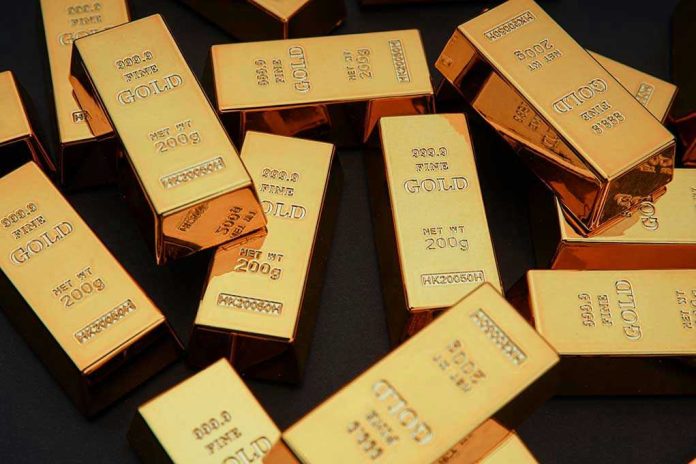
For the first time in decades, central banks worldwide now hold more of their reserves in gold than in U.S. Treasury bonds — and the European Central Bank has the numbers to prove it.
At a Glance
- A European Central Bank report shows gold accounted for 27% of global central bank reserve assets at the end of 2025, compared to 22% for U.S. Treasuries.
- Central banks have been steadily buying gold for years, with China among the largest buyers, driven by geopolitical risk and a desire to diversify away from dollar-denominated assets.
- The shift is partly driven by gold’s soaring price, not just buying volume — using 2023 prices, U.S. Treasuries would still lead at 26% versus 16% for gold.
- The dollar itself remains the dominant global reserve currency; this data reflects a specific reserve-asset category comparison, not a collapse of dollar dominance.
What the ECB Data Actually Shows
According to a June 2026 European Central Bank (ECB) report, gold accounted for 27% of global central bank reserve assets at the end of 2025, up from 20% just a year earlier, while U.S. Treasuries stood at 22%. [1] Multiple outlets, including Morningstar and Statista, independently reported the same figures, reducing the likelihood of a simple data error. [2][3] The ECB measured the share of gold in total official foreign reserves — comprising both foreign exchange holdings and gold — and compared that directly with U.S. Treasury holdings. [3]
The ECB’s own publication frames gold as the second-largest global reserve asset at market prices in 2024, after the U.S. dollar broadly — not simply after Treasuries as a bond category. [10] This distinction matters. Headlines declaring gold the “number-one reserve asset” are technically defensible under one narrow definition, but the ECB itself is careful to note that the U.S. dollar system — encompassing dollar-denominated deposits, bonds, and payments infrastructure — remains the dominant force in global finance. The reserve-share comparison is real; the broader implication of dollar collapse is not supported by the same data.
Central Banks Are Buying — But Price Is Doing Heavy Lifting
Central banks have been accumulating gold steadily for years, with China, India, Turkey, and Russia among the most active buyers. [4] Survey data cited by the ECB indicate that gold is held primarily for portfolio diversification but increasingly as a hedge against geopolitical risk. [10] That motivation has intensified as U.S. sanctions policy has demonstrated that dollar-denominated assets can be frozen — a lesson many governments took from the freezing of Russian reserves following the 2022 Ukraine invasion.
However, the ECB explicitly tested what the numbers look like without recent price appreciation. Using 2023 gold prices instead of current market prices, U.S. Treasuries would still lead global reserve holdings at 26%, compared to just 16% for gold. [3] That gap reveals something important: a significant portion of gold’s rise in reserve share reflects the metal’s price nearly doubling in recent years, not purely a deliberate policy shift by central banks to dump Treasuries. Both factors are real — sustained buying and soaring prices — but conflating them overstates the structural nature of the change.
Why This Matters Beyond the Headline
For everyday Americans, this story connects to something both conservatives and liberals have sensed for years: confidence in U.S. fiscal management is eroding globally. Decades of deficit spending, a national debt now exceeding $36 trillion, and the repeated use of the dollar as a geopolitical weapon have quietly pushed foreign governments to hedge their bets. [6] When the world’s central banks — institutions that are supposed to hold the safest, most reliable assets — start preferring gold over U.S. government bonds, it signals that America’s creditors are hedging against Washington’s fiscal reliability.
Gold Overtakes US Treasuries on Central Bank Balance Sheets
Gold has overtaken the US Treasuries to become the largest reserve asset held by the world's central banks. According to the ECB's report (“The International Role of the Euro”), gold accounted for 27% of global… pic.twitter.com/GfKGwKa9Ox— Headway (@headway_world) June 3, 2026
This is not a crisis announcement. The dollar remains the world’s dominant reserve currency, and U.S. Treasuries remain the largest single sovereign bond market on earth. [7] But the trend line is worth watching carefully. Gold’s reserve share jumped seven percentage points in a single year. [1] Whether that reflects a durable structural shift or a price-driven anomaly that reverses when gold cools off remains an open question — one the ECB data alone cannot answer. What is clear is that the era of unquestioned U.S. financial dominance is being tested, and the world’s central banks are quietly placing their bets accordingly.
Sources:
[1] Web – European Central Bank: Gold Has Replaced US Treasuries as the World’s …
[2] Web – Gold overtakes US Treasuries in global reserve shift: ECB
[3] Web – Gold Has Overtaken the U.S. Dollar in Central Bank Reserves | Statista
[4] Web – How gold overtook U.S. Treasurys as number-one reserve asset
[6] Web – World – Gold in Official Reserves vs. Foreign-Held U.S. Debt (%)
[7] Web – Total reserves (includes gold, current US$) – World Bank Open Data
[10] YouTube – Gold Replaces U.S. Treasuries as Major Reserve Asset. Move Over …