
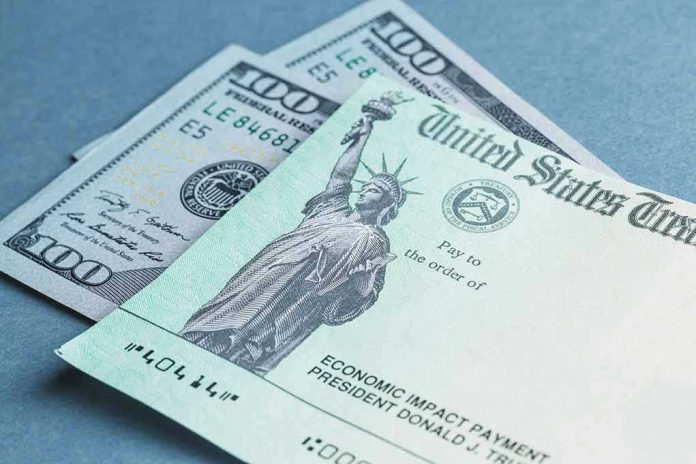
A new policy threatens to destabilize economic promises, leaving many Americans questioning its feasibility.
Story Snapshot
- President Trump’s proposed $2,000 “dividend” payments face skepticism.
- Funding claims rely on controversial tariff revenues.
- Legal and legislative hurdles delay concrete action.
- Economic experts warn of potential inflationary risks.
Trump’s Tariff “Dividend” Proposal Under Scrutiny
President Trump has sparked considerable debate with his proposal to deliver $2,000 “dividend” payments to most Americans, purportedly funded by revenues from global tariffs. While the promise has garnered attention as a populist measure aimed at boosting the economy, critics point out the absence of a formal plan or legislation to back this initiative. Trump’s administration continues to advocate for this scheme, yet clarity on execution remains elusive.
Despite the administration’s optimistic rhetoric, the financial underpinnings of the proposed payouts are murky. The tariffs, initially imposed to protect American manufacturing, are projected to generate substantial revenue, but experts argue that these estimates fall short of covering the proposed dividend costs. The Tax Foundation projects $207.5 billion in revenue for 2026, but the payments could cost between $279.8 billion and $606.8 billion, creating a significant shortfall.
Legal Hurdles and Legislative Challenges
The path to implementing these payments is fraught with legal and legislative challenges. The Supreme Court is currently reviewing the legality of the tariffs under emergency powers, with rulings anticipated soon. Should the tariffs be deemed illegal, the government may face obligations to refund importers, further complicating the funding landscape. Additionally, Trump lacks the unilateral authority to allocate funds for such payments without congressional approval, raising questions about the feasibility of this plan.
Congressional Republicans, who hold critical fiscal oversight, express concerns about deficit growth and the potential for inflation. As gatekeepers of the nation’s purse strings, they remain skeptical of the proposal’s financial viability, emphasizing the need for detailed fiscal analysis and planning before any legislative action can be taken.
Potential Economic Impact
The economic implications of these proposed payments are substantial. Experts caution that injecting billions into the economy without a clear funding source could exacerbate inflation, complicating Federal Reserve policy and potentially undermining economic stability. While the promise of relief is enticing during times of economic uncertainty, fulfilling such promises without solid groundwork could lead to more harm than good.
Many Americans, particularly those in middle and lower-income brackets, are hopeful for the proposed dividends. However, without concrete plans and assurances, the risk of public disillusionment looms large. The administration’s continued exploration of options and its commitment to using tariff revenues “for the American people” offer some reassurance, but until legislative and legal hurdles are cleared, the promise remains just that—a promise.
Sources:
Trump Stimulus Checks Payment for Americans Status
Stimulus Payment January 2026 IRS Direct Deposit Relief Payment Tariff Dividend Fact Check
Trump Tariff Stimulus Checks Could Fuel Inflation, Complicate Fed Policy, Economists Say